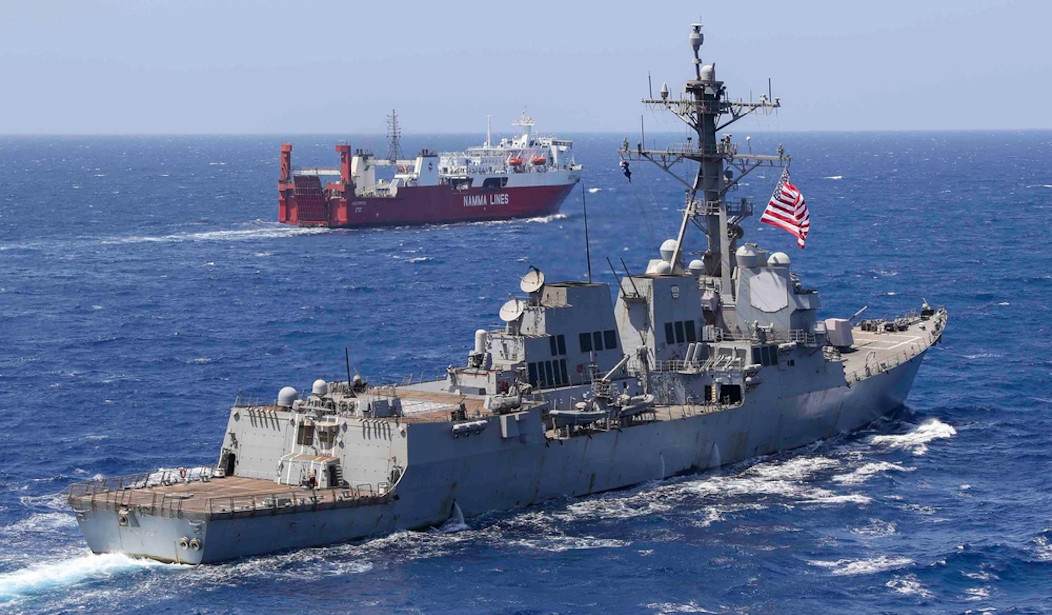
The American military has used a lot of munitions over the last year or so, between slamming down hard on Iran, detonating drug boats in the Caribbean and a few other various operations. Weapons stocks aren't a cornucopia, however, and there has been some speculation as to what shape are stocks are in after all this.
Now, we see two new contracts for arms manufacturer Raytheon, wherein the Department of War is spending $30.7 billion refilling America's missile magazines.
The deals include growing Raytheon’s annual production of the SM-6 to more than 500 and accelerating SM-3 IB manufacturing. Raytheon did not respond to requests inquiring about annual production rate updates for both interceptors.
Raytheon’s DOD agreement also calls for increased yearly production to more than 1,000 Tomahawks and a minimum of 1,900 advanced medium-range air-to-air missiles.
In our current dealings with the mullahs in Iran, we can use weapons designed to take down missiles and drones, as well as weapons to hit ground targets. The Tomahawk, a Cold War-era cruise missile, has shown itself very capable in that latter role. And one never knows why we might need air-to-air capabilities, even though Iran doesn't really have any air assets left.
Here's what we're buying.
The SM-6 interceptor can destroy or minimize missile threats in the air and on the ocean’s surface, such as other warships. The weapon has been paired with the U.S. Army’s Typhon launcher system and the U.S. Navy’s F/A-18 Super Hornet fighter jet and its warships, according to Raytheon’s website.
The SM-3 IB is designed to destroy short- to intermediate-range ballistic missiles during their midcourse flight phase, which begins after the rocket engine burns out and could last up to 20 minutes. The interceptor was first used in combat in 2024, Raytheon said.
Iran does have some ballistic missiles left, and hasn't shown much inclination to stop tossing them around.
Raytheon, a major supplier of munitions, has even more contracts to fulfill.
Raytheon has also signed other contracts that build on its framework agreements inked in February. In August, DOD’s Missile Defense Agency awarded Raytheon a $745 million contract to manufacture and assemble the SM-3 Block IIA All-Up Rounds for the U.S. and Japan Ministry of Defense.
Days later, the Pentagon awarded contracts to Boeing and Raytheon to increase component production for the SM-3 Block IB and the SM-3 Block IIA for an undisclosed amount.
Also in August, the Navy awarded Raytheon a $22.9 billion contract to ramp up production of Tomahawk missiles as well as expand its workforce to produce more weapons in a shorter amount of time.
Of course, the best weapons in this context are the ones you never have to use. But when a person or a country unsheathes their sword, then the blade had better be sharp.
It's too common a trend, by the way, to think of weapons stocks in terms of the kind of conflict we've been fighting over the last few decades: Brush wars, nothing like a near-peer war. The last time we fought a near-peer foe was in 1945. But, as George Santayana said, only the dead have seen the end of war, and we should be looking across the Pacific at China's growing navy and their designs on Taiwan and possibly the Philippines, and making plans for that eventuality, too.
That means building weapons, and plenty of them.
https://redstate.com/wardclark/2026/10/13/the-united-states-is-refilling-its-magazines-with-big-missile-purchase-n2208091



No comments:
Post a Comment