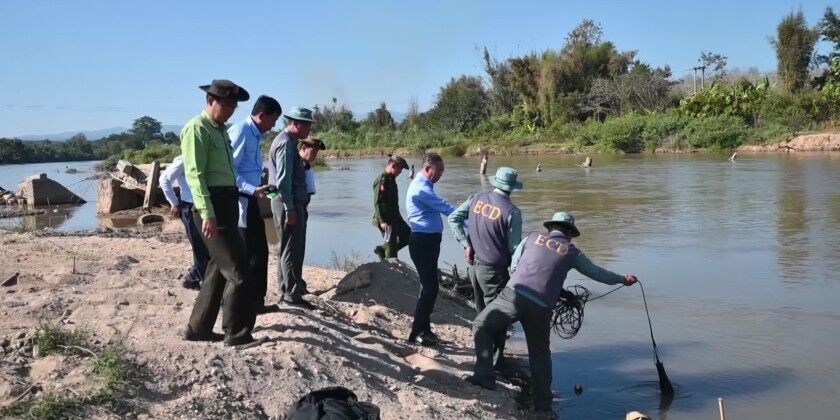
Chinese companies are extracting rare earths and gold from the mountains of eastern Shan State, Myanmar, in territory controlled by ethnic armed groups where government oversight, environmental regulation, and public accountability are largely absent.
Residents on both sides of the Myanmar-Thailand border say they are paying for it with polluted rivers, ruined roads, and deadly working conditions, while the profits flow elsewhere.
Rare earths are essential to electric vehicles, renewable energy systems, electronics, and advanced military equipment. Myanmar was the world’s fourth-largest rare-earth producer in 2024, according to the U.S. Geological Survey, and China is its leading buyer.
Chinese customs data show Myanmar supplied nearly half of China’s rare-earth imports in early 2025. The country’s prolonged civil war has left mining areas beyond the reach of the state, allowing extraction to proceed in conflict zones with little regulation. Local accounts also identify operations allegedly involving Russian interests and actors linked to the Myanmar military.
Across much of the region, the United Wa State Army (UWSA), one of Myanmar’s most powerful ethnic armed organizations, holds sway over land, security, transportation, and natural resources. The UWSA has long-standing commercial and military links with China, and Reuters reported in June 2025 that it protects new Chinese-run rare-earth mines in Shan State. According to accounts from the region, some mining operations depend on arrangements in which companies receive protection while armed groups receive revenue or material support.
Claims that weapons or military supplies are exchanged for security, along with questions about the extent of Chinese government involvement in individual operations, raise concerns that mining revenue may be financing armed conflict.
Mong Yon Township is one area of concern. Parts of the township lie upstream of Tachileik and of Mae Ai District in Thailand’s Chiang Mai Province. Two rivers are of particular importance: the Nam Sai, which runs between Tachileik and Mae Sai, and the Nam Kok, which flows into Thailand through communities in Chiang Mai Province.
Both sustain local livelihoods. In mountainous terrain with interconnected waterways, eroded soil, sediment, and potentially toxic mining waste can travel downstream, reaching farmland, drinking water, and fisheries on both sides of the border.
Sai Aung Kyaw, a Tachileik resident, said Chinese mining companies have operated upstream for years and have recently pushed rare-earth extraction into the mountains. “The Chinese companies are operating upstream. They have been doing this for many years. The places where they are currently mining rare earth are on top of the mountains. They destroy the mountains and dig deep holes into them,” he said.
He also reported gold mining in the Nam Sai River area. During heavy rain, he said, soil, mud, and material from mining sites wash into streams and rivers, worsening water quality and increasing flooding around Tachileik and Mae Sai. Locals have observed abnormalities in aquatic life, and he described the river water as extremely polluted. Before the mining expanded, he said, the streams were cleaner and flooding was less frequent.
Thai government testing supports residents’ concerns. Thailand’s Pollution Control Department has monitored the Kok and Sai rivers since March 2025 and has repeatedly found arsenic above the national limit of 0.01 milligrams per liter, including 0.038 mg/L at the Second Sai River Friendship Bridge in Mae Sai in May 2025. In September 2025, Sai River readings still exceeded the standard, and arsenic was detected in four groundwater wells in villages along the Kok.
Sediment sampled in July 2026 showed arsenic above safe levels at two Sai River points on the Myanmar border. The department has reported that tap water, fish, and residents’ urine samples remained within safety limits.
Residents also point to the trucks. Reuters reported in 2025 that residents had seen trucks carrying material from mines between Mong Hsat and Mong Yun toward the Chinese border, some 200 kilometers away. According to Sai Aung Kyaw, large trucks carrying heavy loads travel through local towns toward the border, sometimes late at night, on roads that were never designed for continuous industrial traffic.
The road surfaces have reportedly deteriorated. Residents rely on these routes for trade, school, healthcare, and farming, and in remote border areas there are often no alternatives. Damaged roads mean longer travel times, higher transportation costs, and reduced access to essential services.
Sai Aung Kyaw said some Chinese companies bring their own workers, food, equipment, and materials from China rather than hiring local residents or buying from local suppliers. If that pattern is widespread, nearby villages bear the environmental and infrastructure costs of mining while receiving few of its economic benefits.
Local workers who are hired face serious danger. According to Sai Aung Kyaw, some dig tunnels beneath mountains, exposing them to collapses and falling earth, and companies do not always accept responsibility or inform families when workers are injured or go missing. He said some workers have been prevented from visiting their families for extended periods, relatives seeking information have faced restrictions, and access to certain mining sites is prohibited, making it difficult for outsiders to verify conditions or investigate accidents.
He also said some young women have entered sex work in connection with the arrival of male businesspeople and workers in mining areas. Where rapid industrial expansion coincides with poverty and weak protection systems, women and girls face heightened risks of coercion, trafficking, and sexually transmitted infections.
Further concerns center on Loi Chileik, a mountainous area in Mong Ton Township near Thailand’s Chiang Mai and Mae Hong Son provinces. Local accounts identify mining around Mong Kyot and Mong Ta, near the Thai border and Chiang Mai’s Wiang Haeng District, in upper watersheds that feed streams used by surrounding villages.
According to local sources, mining in Mong Kyot is associated with Chinese business interests and the UWSA, while operations in Mong Ta allegedly involve Russian interests and Myanmar military-linked actors. These affiliations have not been confirmed through company or ownership records.
Reaching Mong Kyot village requires passing several UWSA checkpoints. Personnel at the checkpoints questioned the purpose of the visit, restricted access to the village, and barred passage to the mining site. One villager said the upper watershed was an important water source for the community, that water quality had deteriorated, and that some residents had switched to wells for drinking water because they no longer trusted the streams.
A Lahu woman of about 50 who sells vegetables at a local market, and who asked not to be named for security reasons, described the disappearance of several young men who worked at a nearby mining site. The men had bought vegetables from her about twice a week until they stopped coming.
When she asked other workers, she was told the men had died after being forced to dig deep tunnels beneath a mountain that then collapsed. She said the company never informed the families of the deaths and instead told relatives the men were still working or otherwise unavailable. Her account could not be independently verified, as the mining sites remain closed to outsiders.
One account described more than 20 trucks carrying materials through the Mong Kyot area at night, although their cargo and destination have not been confirmed. Damaged roads make it harder for farming households to move crops to market, while distrust of local water sources forces families to pay for alternative supplies. The full scale of the damage remains unknown.
The harm does not stop at the border. Contaminated sediment, strained agricultural water supplies, and damaged ecosystems may affect Thai communities that had no role in mining decisions and receive no benefit from the extraction.
The minerals pulled from eastern Shan State enter global supply chains, largely through China’s processing industry, supporting modern technology and the energy transition, while the people living alongside the mines in Myanmar and Thailand bear the risks to their water, land, livelihoods, and safety.



No comments:
Post a Comment