So this is purest speculation on my part. But watching the incredibly complex multi-domain rescue mission this weekend, it suddenly struck me that new, powerful AI might be behind this. Moving all these units into so many places at once, making sure that they have communications organized, fuel, ammunition, food, the right troops with the right transports, and so on is enormously complex. It normally requires the work of hundreds of staffers to do this sort of thing, and that takes time. But it happened awfully fast, and nearly flawlessly.
As Wretchard put it:
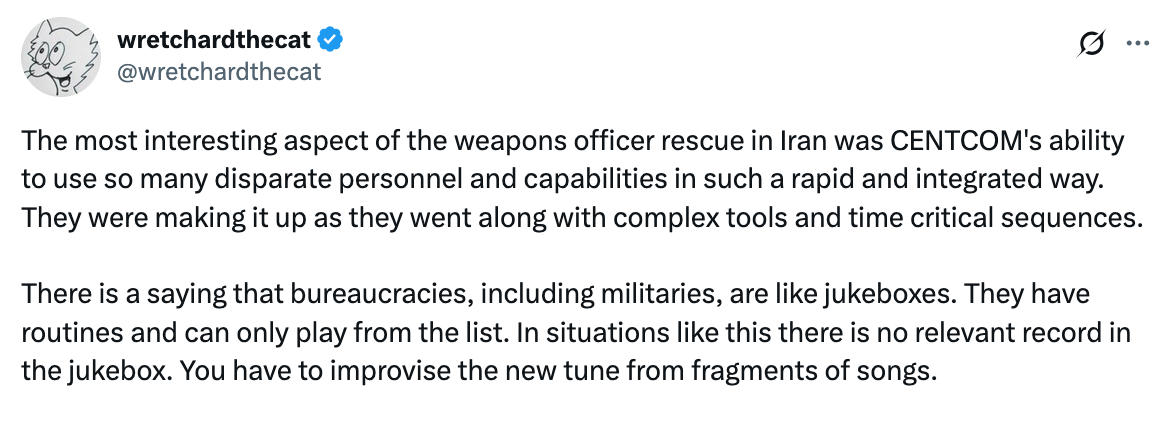
As someone who used to use computers to (literally) improvise new tunes from fragments of songs I got to thinking that all that staff work is the kind of thing that AI is good at. I was talking last night over backyard beers with my neighbor, a CTO who is doing a lot of interesting stuff for his company with AI, and with his son, who is starting up his own, very interesting, AI-based business, and both of their approaches basically use AI to do in minutes what normally takes groups of staffers hours or days to do.
We know, because they told us, that the Pentagon and the IAF have been using AI to identify and track targets. This would be a logical step. Say you want to build an airstrip; AI could identify suitable locations, calculate needed units and resources, allocate them, estimate completion time, and turn it all into orders, etc., etc. And it could do it fast.
Of course, for this to work, you have to have a very sophisticated and high-quality military. Units and resources have to actually be where and what they say they are, commanders have to be prepared to execute orders as soon as they are received, and everyone has to have a very high degree of professional skill to move so fast. (This will make it more difficult for adversaries like Russia and China, for whose militaries those conditions don’t really hold, to copy us). And you’d want humans in the loop still to make sure the orders made sense and were actually doable. But you could get by with far fewer humans (improving secrecy) and much less time (increasing speed).
Is that what happened? Maybe. I’d be inclined to bet on it.
Now looking more broadly, does it seem like Trump is anticipating and outmaneuvering his opponents in general much more effectively than in his first term? Has he perhaps acquired a supporter/ally with a lot of expertise in Artificial Intelligence?




No comments:
Post a Comment