Canadian prime ministers are always trying, and failing, to push back against American power
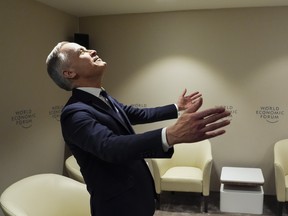
Prime Minister Mark Carney reacts as French President Emmanuel Macron walks into the room for a meeting during the World Economic Forum in Davos, Switzerland on Tuesday, Jan. 20, 2026.
This week Mark Carney applied for the job he really wants: leader of a new “rules-based international order” centred around “middle powers.” It is pretty much the same job that every Canadian prime minister, chafing at American power, has wanted. John Diefenbaker bristled at U.S. expectations that Canada host nuclear weapons, or support its Latin America strategy, and so hoped the British Commonwealth of Nations could exist as almost a rival to the United Nations. Pierre Trudeau embarrassed Richard Nixon by normalizing relations with China first, and Paul Martin oversaw the creation of the G20. Justin Trudeau, of course, tried to lecture the world about how Canada could lead the way on lowering greenhouse gas emissions.
Yet, now that Carney is making a similar play for similar reasons as his predecessors, much of the western media is swooning as if he discovered fire and we are all tasting cooked steak for the first time. He has been described variously as “meeting the moment,” the leader of the “resistance” and even as “Churchillian.” An American conservative writer posted on X that Carney was a “pretty big upgrade” on Trudeau.
This newsletter tackles hot topics with boldness, verve and wit.
Look, an inanimate carbon rod would have been a “pretty big upgrade” on Trudeau, but it is still an inanimate carbon rod, so perhaps some perspective is in order.
During his speech at the World Economic Forum on Tuesday, Carney spoke of a “rules-based order” that “is fading” and about how “we are in the midst of a rupture, not a transition.” It was all a not-so-veiled attack on U.S. President Donald Trump’s admittedly disruptive approach to foreign policy. “Rather than waiting for the hegemon to restore an order it is dismantling” Carney said, the so-called middle powers must “create institutions and agreements that function as described.”
His arguments might have been more persuasive if he hadn’t completely misunderstood why, since the end of the Second World War, the world has been marked by relative stability and peace, at least among western countries and their allies.
Carney spoke as if the “international rules-based order” exists (existed?) as a distinct entity separate and apart from American power. He recognized the “fiction” of such an “order” but argued the fiction was that “the strongest would exempt themselves when convenient.”
In fact, the only reason there is (was?) an “international rules-based order” is because the Americans wanted it. The U.S. didn’t merely help with, as Carney put it, “open sea lanes, a stable financial system, collective security, and support for frameworks for resolving disputes,” it subsidized and backstopped the entire system through the projection of hard power and by creating alliances and relationships around the globe.
Carney merely spoke of amoral “hegemons” completely oblivious to history. After the world wars, rather than retreat into its historic isolationism and permit the world to fall back into a destructive era of multipolar competition, the Americans pledged to protect Western Europe and East Asia. The primary threats came from, as they do today, the Russians and the Chinese.
Neoconservative thinker Robert Kagan put it this way in an essay in the Atlantic this month: “No country had ever before played the role that the traditionally aloof United States took on after 1945.” The Americans chose to transform “the United States into a global force, with responsibility for preserving not just its own security but the world’s.”
Countries around the world permitted the Americans to set up military bases and enter into economic partnerships and trade deals, all of which the U.S. deemed in its interests. Allies participated (mostly) freely and willingly because they similarly benefitted from it. The U.S. is the system. Without it, the world we’ve known since 1945 would not exist.
Carney’s Davos speech contains not just historical errors, but also logical ones, particularly in his use of Václav Havel’s greengrocer. The grocer puts up a sign touting communist propaganda, as does every other business on the block, even though no one believes it. The lie of communist totalitarian regimes is enforced through fear.
Carney twisted this story by likening participation in the post-war order with Havel’s greengrocer: “We participated in the rituals. And largely avoided calling out the gaps between rhetoric and reality.” But this puts a global system that has permitted untold prosperity and security on par with some of the worst regimes of the 20th century.
Michael Kovrig, who spent nearly three years in a Chinese prison, wasn’t buying what Carney was trying to sell, calling it “dangerous” and “subversively horrifying.” Carney’s speech “blurs the difference between democratic hypocrisy and totalitarian coercion,” Kovrig wrote.
Critics of American power have long argued that the security and economic prosperity enjoyed for 80 years didn’t actually require U.S. leadership, and so American power may not be needed at all. Carney, for his part, has called the emergence of a multipolar world a “positive.” But Carney’s hope for American decline may be motivated by nothing more than a desire for him to play a more important role in the world.


No comments:
Post a Comment