A California police union executive director allegedly ran a drug ring from her home and used her office computer and UPS account to order and distribute opioids and other drugs, federal officials charge.
Joanne Marian Segovia, who has worked for the San Jose Police Officers Association since 2003, was charged on Wednesday with attempting to unlawfully import a synthetic opioid called Valeryl fentanyl.
She faces a maximum sentence of 20 years in federal prison if convicted, authorities said.
Police union president Sean Pritchard was shocked by the charges, telling NBC Bay Area, “She’s been the grandma of the POA.”
“This is not the person we’ve known, the person who has worked with fallen officers’ families, organized fundraisers for officers’ kids — just not who we’ve known over a decade.”
According to the 13-page complaint, the 64-year-old allegedly received at least 61 packages at her San Jose home from various countries — including China, Canada and India — between October 2015 and January 2023.
The packages reportedly were marked as food supplements, wedding party favors, makeup, chocolates and other items to disguise the drugs, prosecutors said.
San Jose Police Officers Association executive director Joanne Marian Segovia was arrested for allegedly running a drug ring from her home.
The packages instead contained various drugs, including deadly synthetic opioids and Tapentadol, which is normally used to treat severe pain from nerve damage caused by diabetes.
Prosecutors also allege Segovia exchanged messages on WhatsApp between January 2020 and March 2023 with someone who was using a country code from India.
In one message sent on May 2, 2022, Segovia allegedly wrote, “I’m so sorry, I’m on a business trip because we had 2 officers that got shot! I should be home tomorrow night so ill get them shopped as soon as I can.”
According to the complaint, Segovia took a photo of a shipment she sent to a woman in North Carolina and used the San Jose Police Officers’ Association UPS account.
Homeland Security agents learned of Segovia’s operation while investigating a network in India known to ship drugs into the US.
Investigators found messages from the network that mentioned “J Segovia” with an address in San Jose and the words, “180 pills SOMA 500mg,” according to the complaint.
Although she worked for the police union before being suspended, it is not thought Segovia had a history in front-line law enforcement.
The worker allegedly continued to order the drugs even after she was interviewed by federal agents in February 2023.
Segovia was charged with attempting to unlawfully import a synthetic opioid called Valeryl fentanyl.
Segovia was arrested on March 13 after investigators seized a parcel in Kentucky that was addressed to her.
The package was marked as containing a “clock” and came from China, authorities said.
“I want to thank US Attorney [Ismail] Ramsey and his colleagues for aggressively pursuing the sources of fentanyl coming into our communities and holding drug dealers accountable.”
Former President Donald Trump lashed out at the judge expected to oversee his arraignment in a Truth Social post Friday.
Juan Merchan, acting justice for the New York County Supreme Court, is expected to oversee the arraignment that is likely to take place Tuesday after a Manhattan grand jury voted to indict Trump on Thursday. The former president faces indicted charges for allegedly paying $130,000 in hush money to former porn actress Stormy Daniels prior to the 2016 presidential election.
“The Judge ‘assigned’ to my With Hunt Case, a ‘Case’ that has NEVER BEEN CHARGED BEFORE, HATES ME,” Trump wrote. “His name is Juan Manuel Marchan [sic], was hand picked by Bragg & the Prosecutors, & is the same person who ‘railroaded’ my 75 year old former CFO, Allen Weisselberg, to take a ‘plea’ deal (Plead GUILTY, even if you are not, 90 DAYS, fight us in Court, 10 years (life!) in jail. He strong armed Allen, which a judge is not allowed to do, & treated my companies, which didn’t ‘plead,’ VICIOUSLY. APPEALING!”
Merchan previously oversaw the criminal investigation on the Trump Organization for allegedly withholding salaries, wages and bonuses to benefit executives including Weisselberg, the company’s chief financial officer. Weisselberg pleaded guilty in August 2022 to 15 counts of tax evasion and fraud in a deal that could allow him to be witness against the company in an upcoming trial. He admitted to evading $1.76 million worth of unreported income after the Trump Organization allegedly provided the executive with untaxed perks. (RELATED: ‘Stretching The Law’: DeSantis Reacts To Trump Indictment, Says ‘Florida Will Not Assist’ Extradition)
Merchan sentenced Weisselberg to five months in New York City’s Rikers Island jail complex, five years of probation and required him to pay nearly $2 million in taxes, penalties and interest to the New York City and New York State tax authorities, Manhattan District Attorney Alvin Bragg’s office announced in August.
Bragg’s office has reportedly been in contact with Trump’s legal team to arrange his potential arraignment. The former president, along with prominent Republicans, accused Bragg of allowing violent crime in New York City to run rampant while indicting the former president.
“Manhattan DA Alvin Bragg, who was hand-picked and funded by George Soros, is a disgrace. Rather than stopping the unprecedented crime wave taking over New York City, he’s doing Joe Biden’s dirty work, ignoring the murders and burglaries and assaults he should be focused on. This is how Bragg spends his time!” Trump said Thursday evening.
Merchan started his legal career in 1994, when he served as a Manhattan district attorney. He moved to the State Attorney General’s office five years later, before being appointed to the bench at the Bronx County Family Court in 2006 by former New York Mayor Micheal Bloomberg, according to Ballotpedia.
In October of 2020, days before the 2020 election and the most controversial election in US history, the now-late and great Rush Limbaugh shared one of his most prophetic observations.
Rush shared this with his audience, “They [the Democrats] resent the whole premise behind elections. They don’t believe they should have to persuade anybody to agree with them. ”
Rush knew Democrats were eliminating free and fair elections. There simply was no broad public support behind Democrat ideas. And there still isn’t.
Democrats pushed a candidate in 2020 who could not complete a full sentence, who hid in his basement, and when he did hold a public “rally” he could only get a few dozen supporters to show up in a parking lot to honk horns.
But Democrats were never worried for some reason. You never saw Democrats in full-on panic mode. This was a huge “tell.”
They weren’t campaigning. They weren’t nervous. Their plan was to cheat.
Today Americans are living through the tyranny that follows stolen elections. Democrats are charging hundreds of Trump supporters and raiding their homes. They are holding political prisoners without trial. They are threatening to raid the homes of another 1,000 Trump supporters. They spread fear across the land. Will you be next? Democrats indict a former president on junk charges while they ignore the BANK STATEMENTS that prove Joe Biden and his family were involved in a massive illegal fraud scheme. This is what you get with stolen elections
Rush Limbaugh called this out in October of 2020. The great American radio host told his vast audience what Democrats were up to. And he was right.
They resent the whole premise behind elections. Look, they don’t believe they should have to persuade anybody to agree with them. Therefore, they don’t believe in campaigns. They don’t believe in the free, open exchange of ideas. There aren’t any legitimate ideas outside of their own.
They don’t believe in giving legitimacy to anybody who is not already on their side. So if this is who they are psychologically — if they have no interest in persuading people, if they have no interest in acquiring power as a result of massive public support — then who are they? What are they? They want power simply to have it. They don’t want it to derive from the people.
They don’t want it to derive from persuading people that their ideas are the best — and where is all of that codified? All of that thinking, all of that behavior is codified in elections. What are elections about? Elections are about trying to persuade people to support you, to vote for you. Based on what? Well, it could be any number of things.
It could be you’re better looking than the other guy. You’re gonna give away more welfare than the other guy. You’re gonna beat our enemies better than anybody else. Whatever it is, elections are the result of persuading millions of people to support you. They resent having to do that. One reason is they’re a minority. They can’t persuade a majority of people.
They can’t persuade a majority of Americans to support Black Lives Matter. They can’t persuade a majority of Americans to support burning down American cities and private property. They can’t persuade a majority of Americans to go along with their ideas on guns and eliminating free speech. They can’t persuade anybody to agree with that!
Those are things they’re gonna have to force on people, and they are more than willing and eager to force that stuff on you, but they need the power to do it. So they have to go through the motions. The modern-day Democrats have to go through the motions of campaigning, and they have to go through the motions of trying to win the hearts and minds of voters.
But they resent the hell out of it. And in their world, it’s the one thing standing in their way: This need, this requirement to win elections. And I’m just telling you: As soon as they can figure out a way to eliminate elections, they will do it, ’cause they resent the hell out of it. This is… (interruption) Mr. Snerdley, the program observer, just said to me over the IFB.
He said, “I gotta admit something. When I first heard you say that the left and Democrats ultimately want to do away with elections, I thought you were going insane. I thought you were mad. I thought that all of this had finally gotten to you.” Well, that has to be some years ago now when I first advanced the theory. But now you say you can see it?
(interruption) “They’re doing it in front of our faces.” They really are. They are attempting to win elections without broad public support. That’s what they’re trying to do. That’s just another way of phrasing what they’re doing. How do you win elections without broad public support?
The projector shut off just as Keirstin Erickson started to tear up. She had been watching Jesus Revolution, waiting for the pastor in the movie to baptize the leading man in the ocean. That’s when someone ran into the room, saying that lightning had struck the theater. As the audience chattered among themselves, Erickson sat silent.
“I just remember having this burning sensation in my heart,” Erickson, a 22-year-old training to become a missionary, recalls thinking.
Suddenly she rose from her seat near the front, turned to face the rest of the audience, and introduced herself, asking: “Does anybody need prayer in this room?”
At first it was quiet. But then people started speaking up. A woman in the back confessed she had cancer. A mother revealed her two young sons were at prom that night and said, “Pray for my boys that they will grow up to be godly men, and make good decisions.”
A woman who said she worked with “kids on drugs” poured out her heart with a quivering voice.
“People with addiction are so misunderstood and so judged, and we have hundreds of thousands of kids, including my own children, that are now sober,” said the woman in a now-viral TikTok of the exchange.
“And I just would like you guys to pray for opening your minds to what exactly this movie showed,” she continued. “They’re just seeking something, and it’s God.Keirstin, you just give me hope, girl.”
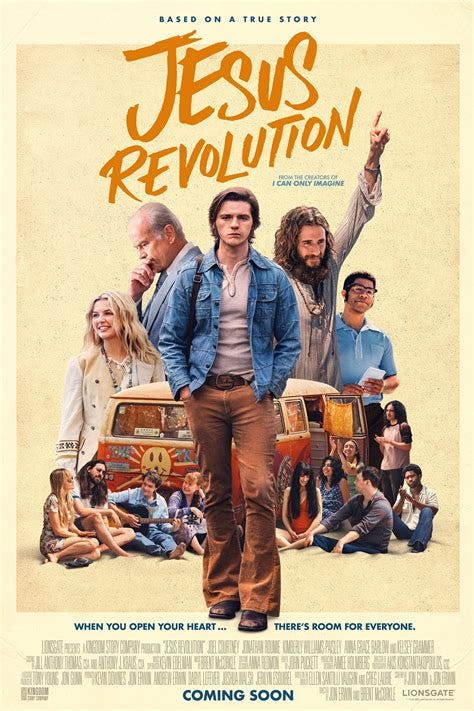
These scenes, more common inside a place of worship, happened last month at Starlight Triangle Square Cinemas in Costa Mesa, California, at a screening of Jesus Revolution, a new movie depicting a real-life 1970s movement that saw thousands of hippies give up drugs for God. That crusade, led by Pastor Chuck Smith with the help of hippie preacher Lonnie Frisbee, coincidentally started at a Calvary Church just a few miles away from the theater where Erickson made her call to prayer.
Inspired by a 1971 Time magazine article about the movement (the codirector bought a copy of the magazine on eBay) and starring Kelsey Grammer as a straitlaced preacher and Joel Courtney as a hippie convert, Jesus Revolution is something of a Hollywood miracle: it’s a religious movie that’s actually a hit.
Made by Christian production house Kingdom Story Company and backed by mega distributor Lionsgate, the film earned back its $15 million budget the weekend it opened, when critics predicted it would gross closer to $6 or $7 million. That’s a triumphant performance compared to the weekend debuts of recent blockbusters, like 65, a sci-fi flick with a $91 million budget that made just $12.3 million, and M. Night Shyamalan’s thriller Knock at the Cabin, which brought in $14.1 million.
Since its release on February 24, Jesus Revolution has grossed $49 million in ticket sales—besting many of this year’s Oscar nominees combined at U.S. box offices.
Jon Erwin, the co-director of Jesus Revolution, told me his goal is to revive the multigenerational entertainment experience at the cinema.
“Now everyone has their own screen, everyone has their own sort of content, and you feel alone in your own home,” Erwin said. “I went to the premiere of the movie with my wife, my daughter, and our parents, and you have three generations loving the movie together. That is the most needed thing in entertainment right now, especially a story that centers around a set of values that I think is good for the world.”
Roma Downey, who runs LightWorkers Media, a faith-based division of MGM, agrees, saying Jesus Revolution “is a very good story, well-told. It didn’t hurt that they have the name ‘Jesus’ in the title. For Christians, that’s attention grabbing. It’s a provocative title.”
Christian colleges and church groups around the country have been pouring into theaters. One couple in Madisonville, Kentucky, bought out an entire day’s showings of the film earlier this month just so everyone in their town could see it for free.
Also, Downey said, “People are hungry for goodness, people are hungry for change”—especially after the pandemic. “For a minute it looked like the world as we knew it was coming to an end, then what were the things that were important? I think it helped people refocus on family, faith—those sort of values.”
Jesus Revolution marks the sixth—and most successful—movie from Kingdom Story Company, a partnership between producer Kevin Downes, producer Tony Young, and brothers Andrew and Jon Erwin to make Christian entertainment exclusively for Lionsgate. The Erwin brothers, whose stated mission on their website is “spreading the message of the Gospel through film,” first got Hollywood’s attention when their $7 million budget drama, I Can Only Imagine, grossed over $85 million in 2018.
Christians in Hollywood—no, not an oxymoron, just an endangered species—hope that its success means more Christian films will be greenlit. There’s a desire to give the faith-based audience “movies that they can embrace and enjoy,” says Paul Dergarabedian, a media analyst at Comscore, an agency that records metrics on film and TV viewership. “But you also have to be able to prove that you can make these films profitable to justify future investment. And Jesus Revolution really puts a fine point on that with its performance.”
Ever since Mel Gibson’s Passion of the Christ brought in over $600 million at box offices worldwide in 2004, studio executives have been trying to resurrect its success. In 2007, Sony launched its own faith-based studio, Affirm Films, which often teams up with Alex and Stephen Kendrick, the brothers behind profitable Christian movies like War Room and Fireproof.
Rich Peluso, who runs Affirm Films, says that Sony and other studios began investing more in faith-based movies once they saw that dramas like War Room—which had a budget of $3 million but made almost $74 million—could deliver massive returns.
“If they would have done Jesus Revolution five or ten years ago, they probably would have only been able to scrape up half the budget and it would have been half as good. For me that’s the change—that the studios, like for me, Sony Pictures, are willing to invest more. And whereas years ago, they weren’t. The budgets were much, much more modest.”
Late next month, Affirm is set to release its highest budget film yet, Big George Foreman: The Miraculous Story of the Once and Future Heavyweight Champion of the World, based on the true story of the boxer-turner-preacher and starring Forest Whitaker of Black Panther fame.
A-list actors now routinely star in films with religious storylines—like Mark Wahlberg, who played another boxer-turned-priest in the 2022 film Father Stu, and Hilary Swank, who’s set to headline Kingdom Story Company’s next project this fall, Ordinary Angels—a film about a Kentucky hairdresser who helps cobble together money for a young girl’s liver transplant. Jesus Revolution undoubtedly got a boost from its star, Kelsey Grammer, famous for TV hits like Cheers and Frasier, and his costar Joel Courtney—a teen heartthrob who previously starred in The Kissing Booth, a successful mainstream teenage comedy on Netflix.
Angel Studios, a crowdfunded production house that has raised tens of millions, has also popped up to meet the demand for Christian content. Episodes of its streaming series The Chosen, a dramatic retelling of the life of Jesus, have been watched over 450 million times since 2019, when the first season became available on the show’s free app—but many studio executives, including Jared Geesey, who now oversees distribution at Angel Studios, initially passed on investing in the show.
“Everyone was passing on it, both in Hollywood and the faith industry because the model for Christian television was kind of broken and couldn’t really fund a show like that,” Geesey told The Free Press.
Now, he says Angel Studio’s crowdfunding business model bypasses the “gatekeepers” of Hollywood, since its thousands of investors—ordinary people—vote on which projects to greenlight.
On March 31, Angel Studios will release its first film in theaters: His Only Son, a biblical drama covering God’s command that Abraham sacrifice his beloved child. The filmmaker, David Helling, is a Marine veteran who put himself through film school on the G.I. Bill after returning from Iraq, and edited the film himself, completing its special effects and even designing the costumes.
“It looks like ten times the budget,” Geesey says. “It’s this little indie film that again, nobody would’ve picked this up in the traditional model.”
Currently 1,900 screens are scheduled to show the movie across the U.S., but he says they’re adding new theaters to the rollout every day.
Meanwhile, Roma Downey, who runs LightWorkers Media with her husband Mark Burnett, the creator of Survivor, is releasing a new Christian film on Amazon Prime called On a Wing and a Prayer, starring Dennis Quaid and Heather Graham, on April 7.
That doesn’t mean that Hollywood has entirely made its peace with Christianity. On March 11, actor Rainn Wilson, most famous for his role as dweeby Dwight in The Office, tweeted about “an anti-Christian bias in Hollywood,” referencing the arc of a cult-like preacher on HBO’s zombie series The Last of Us.
“As soon as the David character in ‘The Last of Us’ started reading from the Bible I knew that he was going to be a horrific villain,” Wilson tweeted. “Could there be a Bible-reading preacher on a show who is actually loving and kind?”
Jon Erwin, who co-helmed Jesus Revolution, says Hollywood’s contempt for faith-based entertainment is something he’s talked about with famed horror producer Jason Blum. Erwin says the two have bonded over “serving” audiences the film industry often overlooks.
“One of the things we really talked about was the idea that ... an audience can feel disdain,” Erwin told me. “Certainly a faith audience at times feels disdain, and oftentimes any portrayal of a religious figure in a television show is negative. There are very few positive portrayals.”
David A.R. White, founding partner of Pure Flix, a Christian streaming service that Sony acquired in 2020, says he remembers sitting on his curb in Los Angeles with Downes, the Kingdom Story Company producer, decades ago, thinking: We can do better than what’s out there. A young actor at the time, White was used to seeing Christian movies with low budgets and poor scripts.
“We were just thinking and dreaming going, ‘Someday, wouldn’t it be cool if the studios had faith divisions, and these movies were able to be in theaters, and people would look at it as an actual genre?”
He would go on to produce the God’s Not Dead franchise, which White called a “massive breakthrough” when the first film came out in 2014, racking up over $60 million in ticket sales from a $1.1 million budget. Many film critics later called 2014 “the year of the Bible.”
White points out how many Americans go to church—about two-thirds of Americans identify as Christian, with about two-thirds saying they attend church at least monthly, according to the most recent data.
“That’s a lot of people,” White says. “So to not have any faith-based movies, or even say it’s a genre, I don’t think it was fair. I thought it was just a marketplace that needed to be filled. And that’s really where our passion was fueled to change the way Hollywood looked at these faith films.”
Back in Costa Mesa, Keirstin Erickson says Jesus Revolution is sparking a movement beyond theaters. After her screening ended, a group of college students came up to her in the hallway, crying, asking if they could pray together.
“They were telling me that because they saw me call strangers to prayer they believed that they could also stand up for what they believe,” says Erickson. “And that they could help their generation.”
“People were amazed and inspired by the movie, but it also sparked a revelation, that revival is happening right now,” she added. “And that we’re living in it, and anybody can be a part of it.”