Carney spoke to U.S. President Donald Trump by phone on Monday
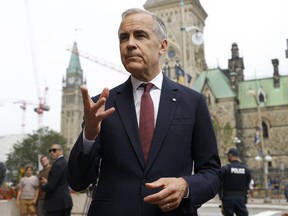
Prime Minister Mark Carney speaks to journalists about U.S. President Donald Trump's new 50% tariff threat in the Parliamentary Precinct in Ottawa July 21, 2026.
OTTAWA – New U.S. tariffs are set to hit $29 billion worth of Canadian goods as of midnight Wednesday, unless Canadian and American negotiators can come to an agreement.
Carney spoke to U.S. President Donald Trump by phone on Monday. Earlier during a press conference on Monday, the prime minister remained tight lipped about the negotiations, describing them as very delicate and intense.
OTTAWA – New U.S. tariffs are set to hit $29 billion worth of Canadian goods as of midnight Wednesday, unless Canadian and American negotiators can come to an agreement.
Carney spoke to U.S. President Donald Trump by phone on Monday. Earlier during a press conference on Monday, the prime minister remained tight lipped about the negotiations, describing them as very delicate and intense.
Canada-U.S. Trade Minister Dominic LeBlanc and Chief Trade Negotiator Janice Charette have remained in Washington this week. LeBlanc and Charette met with United States Trade Representative Jamieson Greer and United States Secretary of Commerce Howard Lutnick on Monday.
Following that meeting, LeBlanc told reporters, “Our job is not yet done.”
Canadian negotiators have been in Washington for the last several weeks after Trump threatened to impose a 50 per cent levy on a range of Canadian goods, from alcoholic products to hockey sticks, effective 12:01 a.m. on Aug. 19. The president used Section 338 under the Smoot-Hawley Tariff Act.
During trade discussions, Canada is also hoping to get relief on Section 232 tariffs on Canadian autos, lumber, steel and aluminum.
The U.S. has cited trade irritants such as U.S. alcohol boycotts in provinces, counter tariffs on American autos and Canada’s dairy supply management system as the reasons for the latest trade action.
Carney said on Monday that his government has plans for every eventuality. Sources told the National Post that the federal government is in the process of preparing a relief package for businesses, should the Section 338 tariffs go through.
The prime minister has also not ruled out retaliation.
On Tuesday, the U.S. Chamber of Commerce urged the two parties to reach a deal.
“The introduction of higher tariffs would damage both economies, drive up costs for U.S. families, further disrupt critical supply chains, and risk the 13 million American jobs that depend on trade under the U.S.-Mexico-Canada Trade Agreement (USMCA),” said Neil Herrington, senior vice president for the Americas department at the U.S. Chamber of Commerce, in a statement.
Herrington said a deal that would see a reduction in Section 232 tariffs on Canadian industries and the return of U.S. alcohol to Canadian shelves in addition to better market access for U.S. dairy producers would be “be a boon to U.S. consumers, producers, farmers and manufacturers.”
Meanwhile, Canadian Labour Congress president Bea Bruske also released a statement on Tuesday, urging the Canadian negotiating team to not be afraid to walk away from a bad deal.
“Canadian workers need a deal that protects good jobs, strengthens our economy and delivers real stability for workers and communities,” she said, in a statement.
“Canada must be prepared to hold firm on our interests and our red lines, while also having a clear plan to support workers and communities if tariffs come into effect,” she added.
More to come.
Following that meeting, LeBlanc told reporters, “Our job is not yet done.”
Canadian negotiators have been in Washington for the last several weeks after Trump threatened to impose a 50 per cent levy on a range of Canadian goods, from alcoholic products to hockey sticks, effective 12:01 a.m. on Aug. 19. The president used Section 338 under the Smoot-Hawley Tariff Act.
During trade discussions, Canada is also hoping to get relief on Section 232 tariffs on Canadian autos, lumber, steel and aluminum.
The U.S. has cited trade irritants such as U.S. alcohol boycotts in provinces, counter tariffs on American autos and Canada’s dairy supply management system as the reasons for the latest trade action.
Carney said on Monday that his government has plans for every eventuality. Sources told the National Post that the federal government is in the process of preparing a relief package for businesses, should the Section 338 tariffs go through.
The prime minister has also not ruled out retaliation.
On Tuesday, the U.S. Chamber of Commerce urged the two parties to reach a deal.
“The introduction of higher tariffs would damage both economies, drive up costs for U.S. families, further disrupt critical supply chains, and risk the 13 million American jobs that depend on trade under the U.S.-Mexico-Canada Trade Agreement (USMCA),” said Neil Herrington, senior vice president for the Americas department at the U.S. Chamber of Commerce, in a statement.
Herrington said a deal that would see a reduction in Section 232 tariffs on Canadian industries and the return of U.S. alcohol to Canadian shelves in addition to better market access for U.S. dairy producers would be “be a boon to U.S. consumers, producers, farmers and manufacturers.”
Meanwhile, Canadian Labour Congress president Bea Bruske also released a statement on Tuesday, urging the Canadian negotiating team to not be afraid to walk away from a bad deal.
“Canadian workers need a deal that protects good jobs, strengthens our economy and delivers real stability for workers and communities,” she said, in a statement.
“Canada must be prepared to hold firm on our interests and our red lines, while also having a clear plan to support workers and communities if tariffs come into effect,” she added.
More to come.


No comments:
Post a Comment