Let's normalize plain speaking
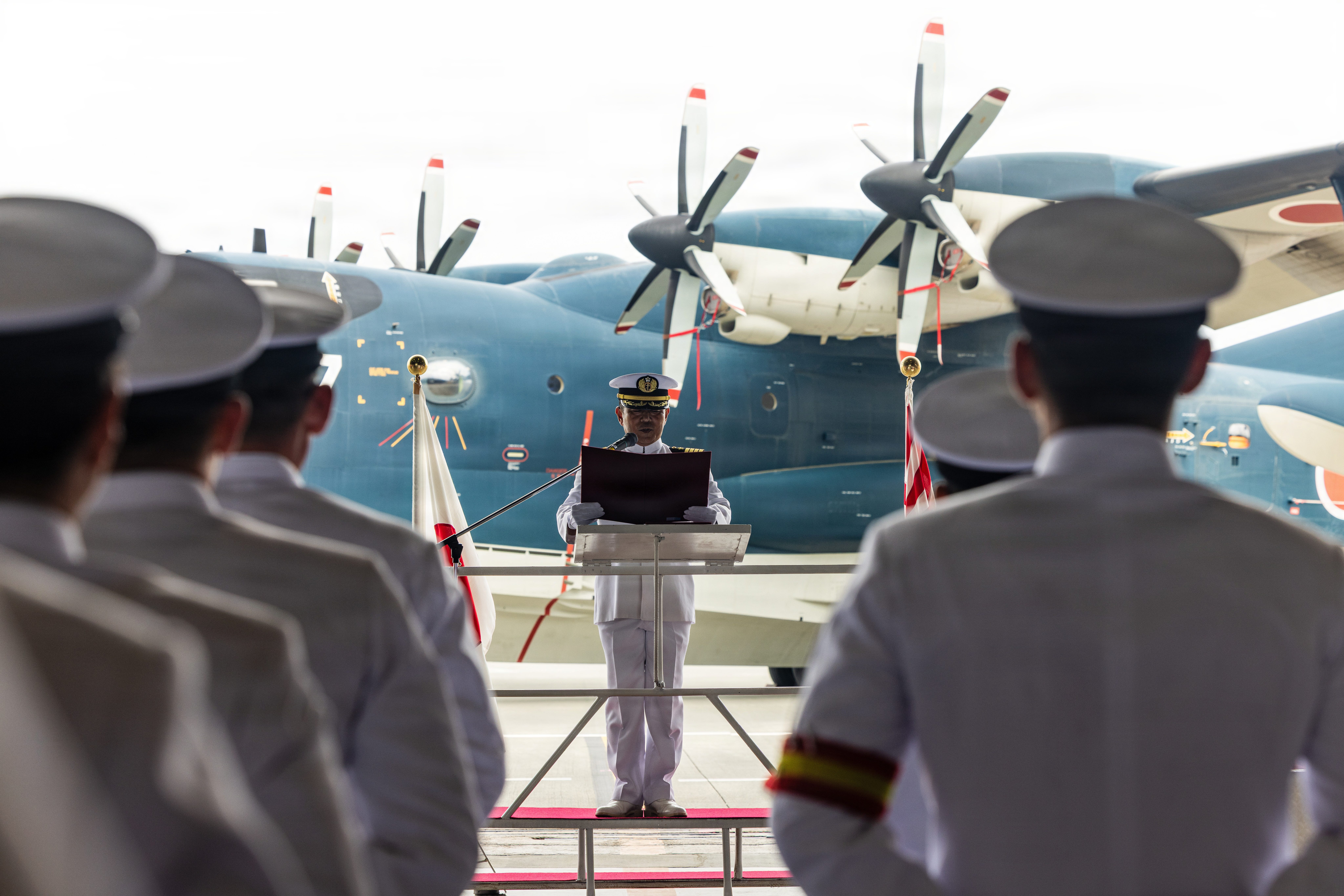
A very strange and rather short article came out yesterday from Richard Fontaine, the CEO at the Center for a New American Security (CNAS).
I shouldn’t have to say this, but I will: this isn’t personal, this is professional.
I had to double-check the publication date as it just read, well, strange. But no, August 4th, 2026. Its title, Japan isn’t rearming. It’s adapting to a new era. It is something if it were written by someone else, I might ignore…but Richard isn’t just some rando anon pounding away on Substack…so here we go.
In the name of all that is holy. I know Richard has been in DC a long time and is well soaked in the Beltway NATSEC miasma…but someone has to put a marker down, might as well be me.
I’ll get to the substance in a minute, but let’s discuss word choice, clarity, avoiding hyperbole, and directness. Yes, even with all my inadequacy as a writer, even I feel more than comfortable “going there.”
From the first time I was told to write my own FITREP in the final years of the Cold War to spending almost half my active duty career on U.S. and NATO staffs, I understand the dark art of finding the words to not say what you want to say, or worse, try to craft an alternative universe with words for whatever reason personal, professional, or to just answer the mail.
I also learned that if you find a topic enthusiastically inserted into a larger article that is only tangentially or remotely related to the main topic at hand, then that is a signal of an author’s real obsession that they would prefer to write about, as opposed to what they are obliged to write about.
So, we have the topic of Japan’s final stretch past the 20th century adhesions that has kept her unnecessarily off the global stage. An important topic. A serious topic. A trend we first glimpsed in the days right after the attacks of 2001.
A quarter century later and well-past the summer solstice of 2026, when you look west of the International Date Line, Japan is one of the most popular nations in the Pacific rim from Taiwan to New Zealand. Even the South Koreans have softened their view of Japan, in a fashion, especially when it comes to defense issues. There are only two nations who are worried about Japanese military power, the People’s Republic of China (PRC) and North Korea.
With that set, let’s dive into a few of Richard’s comments.
Japan is indeed undergoing a defense revolution today, but it’s not rearmament. The SDF has for years represented an advanced, highly capable military force. While it is growing stronger, more important than the additions are what is being removed. Tokyo is systematically eliminating the self-imposed constraints that hobbled Japanese defense for decades. It is adapting to a new, more threatening Indo-Pacific security environment and greater global uncertainty. Washington should welcome and assist this transformation.
Just stop. It isn’t just Richard who does this. Everyone, just stop. You know you are not speaking clearly. We know you are not speaking clearly. You know that we know that you are not speaking clearly—and yet you continue not to speak clearly and we pretend not to notice.
Just stop. This got tiresome during the Age of Transformation™ and is just silly.
Japan is not undergoing a “revolution.” You could say, “evolving”…maybe, but what she is doing is something I and others have been asking for over the better part of two decades: she is acknowledging that this is the 21st century—indeed we are now entering the 2nd quarter of the 21st century—and it is time that she leaves the ghosts of the mid-20th century behind and take her rightful place as a full member of the free world.
She is returning. You do not have to be at “0” in order to rearm.
The “Washington should” begs the question—who in Washington isn’t? Indeed, who in Washington, Canberra, Wellington, Manila, Taipei, and even Seoul and Hanoi are not generally giddy that Japan is building up her defensive capability in the face of an increasingly aggressive PRC?
For decades after World War II, Japan was pacifist but certainly not unarmed. Tokyo spent, for example, a higher percentage of its GDP on defense in the 1950s than it does today. By 1989, largely as a result of the strong yen, Japan briefly had the world’s third-largest defense budget. In the early 1990s, the ground SDF was about a fifth larger than it is today, and it once had nearly twice the number of tanks it now possesses. Claims that Japan is rearming today suggests that Tokyo was unarmed in previous decades. Nothing could be further from the truth.
Where to start here? Goodness, I will have to go to bullets (no pun intended):
When you have the world’s 2nd to 4th largest economy, even if you spend 1% or less on defense, you will have a strong defense. Anyone who has served in the Pacific over the last half century has exercised with the Japanese. I’m still recovering from a few nights in Waikiki with their Navy in RIMPAC 2002. No serious person has ever thought Japan was unarmed, toothless, or without talent or skill. No one.
In the early 1990s, every Western or Western-adjacent nation allied to the U.S. had a much larger military and an ungodly amount of tanks…then the Soviet Union evaporated, everyone thought a rising China was good for their 401K, and the Peace Dividend era did the rest.
Again…no serious or informed person has thought Japan was unarmed for decades. The U.S. rearmed in the 1930s…but before 1936, we were not unarmed. This is just silly. It would be helpful if he named names here, because I have not seen it.
Let’s review the graph.
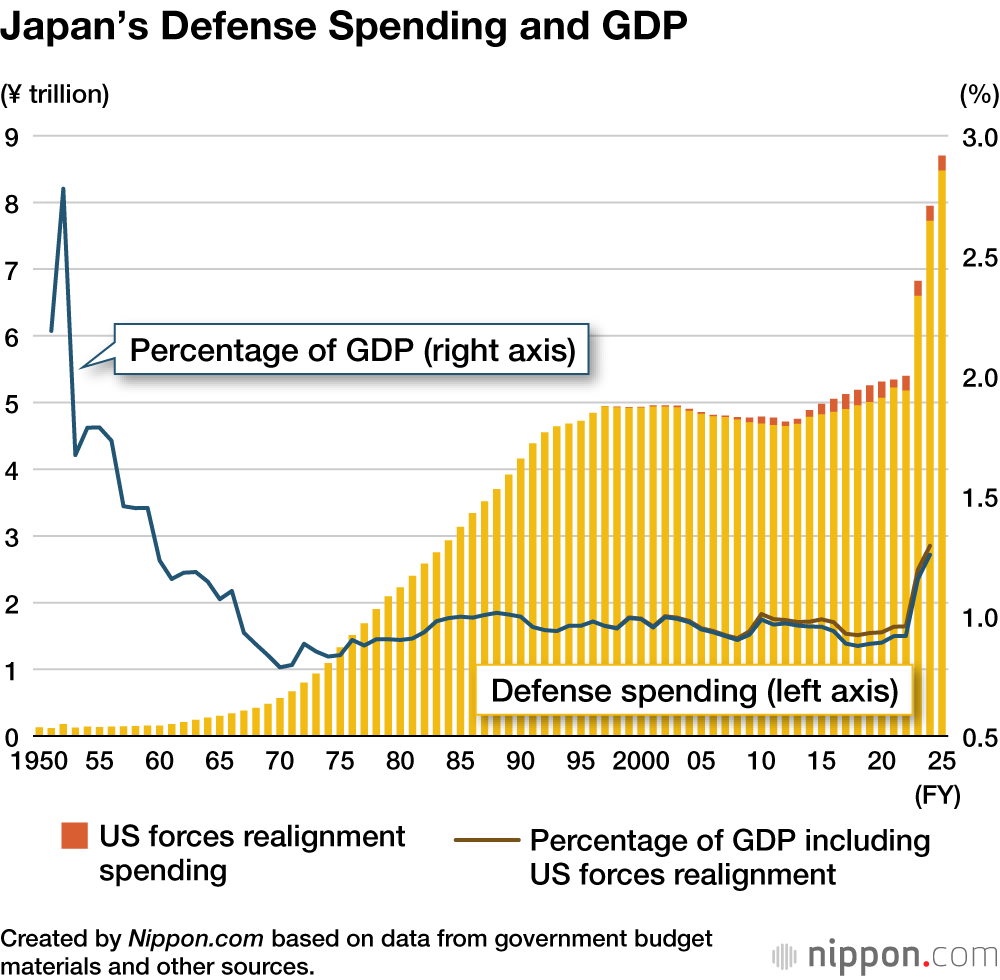
No one was disarmed, however, there was a difference in effort relative to the U.S.
Here’s a similar graph for the U.S. over a similar timeframe.
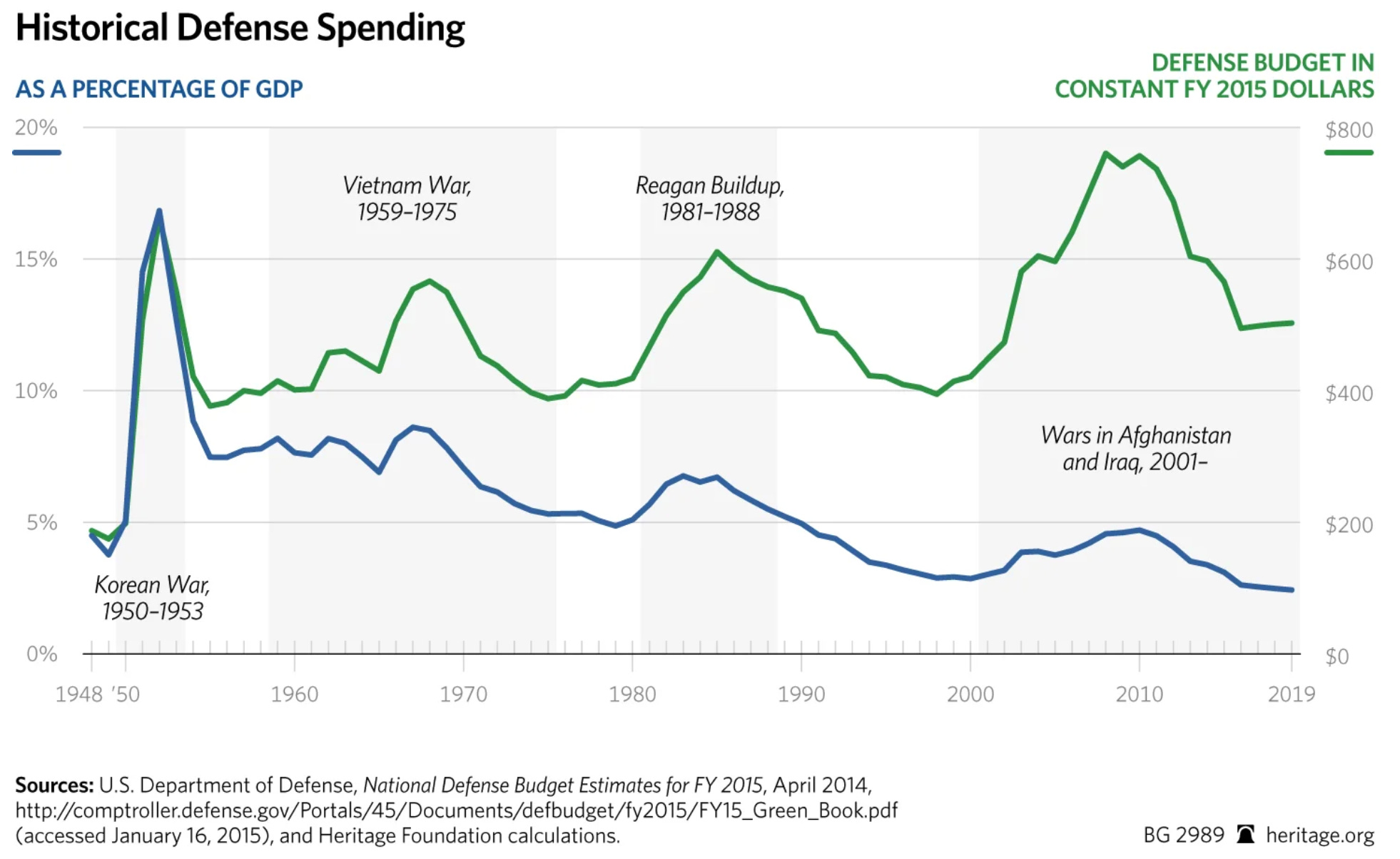
Fun historical note about the spike for both nations in the Korean War Era: everyone here does realize that Japanese contributed to the fight, lost ships and men during the Korean War, right? If not, read up.
Back to the article.
I am beginning to wonder, did Richard’s intern write this article?
In 2022, Japan’s National Defense Strategy sounded the alarm in uncommonly direct terms. “Amid the most severe and complex security environment since the end of WWII,” it said, “Japan needs to squarely face the grim reality and fundamentally reinforce Japan’s defense capabilities.” The combination of China’s growing power projection and its aggressive foreign policy…focused minds in Tokyo. Russia’s invasion of Ukraine in 2022 further alarmed Japanese political leaders and defense planners. Suddenly the unthinkable—the forcible conquest and annexation of sovereign territory—was possible, then in Europe but perhaps tomorrow in Asia.
The stimulus for Japan’s defense revolution has only increased in intensity since then. China continues to grow in military strength and ambition, and North Korea remains a stubborn and nuclear-armed provocateur. And then there is the United States, Japan’s sole ally and the guarantor of the country’s security. American reliability and focus are newly in doubt.
The hyperbole, again. Once more to the bullets:
The 2022 NDS did not emerge from the head of Zeus. This has been building in Japan for quite some time. Again, I vaguely remember a conversation with a JMSDF LCDR at 2am in a cloud of —well if you have been on liberty with the Japanese, you understand—on this exact topic.
No one thought in January 2022 that “forcible conquest and annexation of sovereign territory” was “unthinkable”. Am I the only one around during the breakup of the Soviet Union and the Balkans’ cascading challenges during the 1990s? NATO gave me a medal for helping with the “forcible conquest and annexation of sovereign territory” after all. Has anyone besides me paid attention to Africa this century?
The DC nomenklatura’s desire to find some way to throw-poo-at-DJT seeps in everywhere. America has spent a decade—and the last 18 months pissing off all sorts of Europeans—in an attempt to finally manifest Obama’s pivot to Asia to bolster our Pacific allies. The last sentence in the above quote is just out of place in the context of Japan. Wildly. “American reliability and focus are newly in doubt.“ is simply not supported by the facts when it comes to Japan. In other places, well meaning people can argue here and there, but in Japan in a security context? A silly exaggeration.
Speaking of an inability to focus on the topic without finding some way to run off on a “throw-poo-at-DJT” tangent, what exactly does this disjointed and non sequitur laden paragraph have to do with the price of tea in China?
The Trump administration has had an inconsistent approach to the alliance. At the operational level, the two countries have never worked together more closely. President Donald Trump oscillates between praise for Prime Minister Takaichi Sanae and criticism of Japan for ripping off the United States. The administration imposed tariffs on Japan and demanded that it raise defense spending as well as clarify its role in a Taiwan contingency. After Takaichi publicly did so, China retaliated with a raft of punitive measures that elicited mostly silence from Washington. Japan strives to focus American attention and resources on the Indo-Pacific but watches as yet another costly and inconclusive war in the Middle East absorbs Washington’s attention. A poll last year showed that more than 75 percent of Japanese did not believe the United States would defend their country.
Next time I think that too often I drift off topic to the detriment of one of my posts, I will think of this paragraph and then not feel so bad about myself.
Tokyo’s pursuit of a more powerful, less-constrained military serves two purposes simultaneously. Japanese leaders seek to demonstrate their value to the alliance, helping assure America’s continued commitment. But a stronger military also helps Japan hedge, both against the region’s rising threats and the possibility of U.S. inconstancy. Takaichi’s moment of domestic political dominance has freed the Liberal Democratic Party to unshackle its defense policy. And it is doing so quickly.
OK, this is a good paragraph. There are a lot of things that Japan is doing almost in plain sight—and has for decades—as a hedge. The Japanese are smart. This is well known and accepted. We would do no less.
The acquisition of new defense capabilities has been particularly striking. Japan has bought long-range strike weapons, including Tomahawk missiles that allow it to hit targets more than 1,000 kilometers away. It effectively has two aircraft carriers and F35 aircraft that can fly from them. Japan is developing a hypersonic glide vehicle, working on joint development of a sixth-generation fighter, and seeks nuclear-propelled submarines. As global demand for missile interceptors vastly outstrips supply, Japan is manufacturing Patriots—and selling them to the United States.
If the U.S. were “inconsistent”, “inattentive”, or “unreliable”—would U.S. built and designed weapons in this paragraph and the close coordination our defense industry with theirs on product development even exist?
No. Of course not.
The article returns to soundness, but again, this is not revolutionary. This is just a natural return.
Budgets continue to rise, and Takaichi pledged to hit the previous target—spending 2 percent of GDP on defense—two years early. Japan will be just under this figure at the end of 2026 and is sketching out future increases. Today, Japan has become the world’s tenth-biggest defense spender. The organizational framework is changing as well. Japan last year established a new Joint Operations Command that will allow for quicker, more effective decision-making and planning.
In April, Japan relaxed its longstanding ban on the export of lethal weapons and has sealed a multibillion-dollar deal to sell warships to Australia. Its newly announced National Intelligence Bureau represents the first centralized intelligence agency in Japan since 1945. Japan and the United States have begun a dialogue on extended nuclear deterrence. And by the end of this year, three key strategic documents—the National Security Strategy, the National Defense Strategy, and the Defense Buildup Program—will be rewritten and reissued. Perhaps most ambitiously, Takaichi in May called for a debate on revising the Japanese constitution, ensuring that it is “updated to reflect the demands of the times.”
The final paragraph almost reads as if I wrote it…except for…
Above all, however, the United States should welcome Japan’s emergence as a “normal” country, one that is active not just at home but in its region and that has a defense posture and policy befitting a key American ally. Tokyo today is not rearming but relaxing the many constraints that tied down its military. Eight decades after the worst war in history, and at a time of rapid geopolitical disorder, the United States should help usher in Japan’s adaptation to a new era.
Why the “should”? The U.S. has been encouraging this for a very long time. I don’t know anyone who is not a China-dove/shill who is worried about Japan’s increasing defense posture.
Why the hesitancy to say they are, “rearming”? Like I started this post with, this is silly word-games. I’m sorry, but when you double defense spending in under half a decade, you are “rearming”. Heck, right now the U.S. is “rearming” to refill our already shallow magazines that have become even shallower in the last few months.
So, folks help me here—what was driving Richard to write this article in a way to bob-and-weave like this? It seems like a missed opportunity that trips all over itself.
What am I missing?



No comments:
Post a Comment