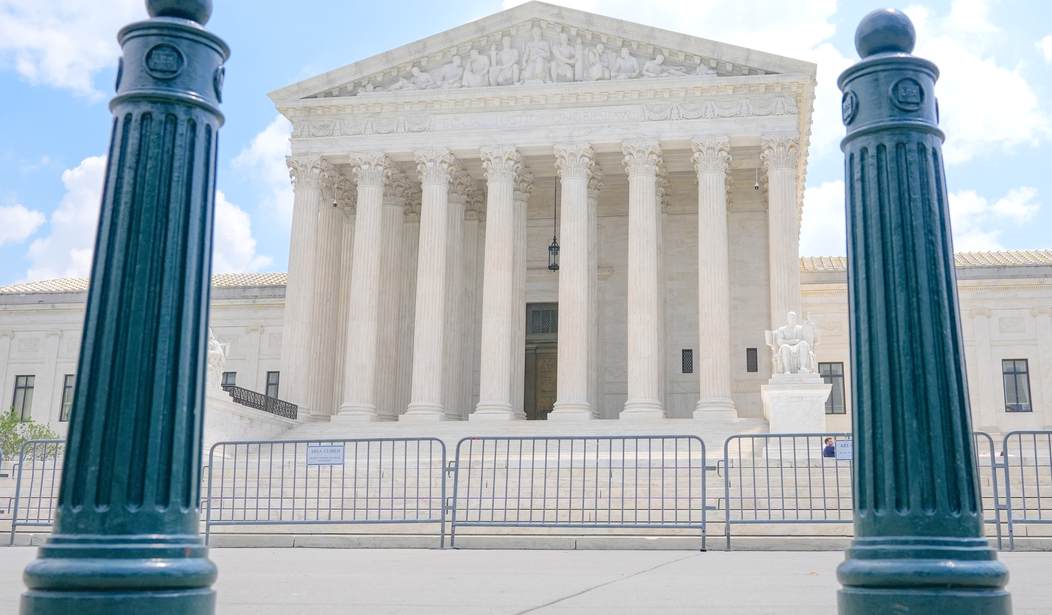
How much money can a national party spend in coordination with a candidate? There are limits, and the National Republican Senatorial Committee asked the Supreme Court to weigh in. This isn’t the most exciting of all cases, but campaign finance riles up Democrats for some reason. How many ads and fundraising materials did we see following Citizens United? It was overkill. The difference is that the GOP has the upper hand regarding campaign cash for the 2026 cycle; Democrats are virtually broke.
The area of campaign finance now has greater clarity, as the Court ruled 6-3 to strike down its 2001 ruling in Federal Election Commission v. Colorado Republican Federal Campaign Committee. Political parties can now spend whatever in coordination with their own candidates, a win for the First Amendment.
Admittedly, even SCOTUS experts and reporters had no clue where this decision would land. Oral arguments were held last December. At the same time, when this case was brought before the appeals court, they noted the plaintiffs had good arguments, but were bound by the 2001 ruling, per Amy Howe of SCOTUSblog (via SCOTUSblog):
https://townhall.com/tipsheet/mattvespa/2026/06/30/the-supreme-court-just-issued-a-new-ruling-on-campaign-finance-n2678550Nearly a quarter-century ago, the Supreme Court rejected a challenge in Federal Election Commission v. Colorado Federal Republican Campaign Committee to the constitutionality of limits on the amount of money that political parties can spend in coordination with a candidate for office. On Tuesday, Dec. 9, the justices will hear oral arguments in a case, National Republican Senatorial Committee v. Federal Election Commission, asking them to strike down the coordinated party expenditure limits and, if necessary, overrule that 2001 decision.
Defending the limits, the Democratic National Committee argued that a ruling in favor of the challengers “will fundamentally reshape the campaign finance regime.” The group cautioned that a decision holding that a constitutional right to “engage in unlimited coordinated expenditures” would likely also lead to the elimination of any limits on their contributions to a candidate.
The challengers countered that the real negative impact would come if the Supreme Court were to leave its 2001 decision in place. Doing so, it said, “would work a sea change in this Court’s jurisprudence, calling its recent campaign-finance precedents into doubt.”
The dispute dates back to 2022, when four challengers – the National Republican Senatorial Committee (a group focused on electing Republicans to the Senate), the National Republican Congressional Committee (which focuses on electing Republicans to the House), then-Sen. J.D. Vance, and Steve Chabot, then a member of Congress from Ohio – went to federal court. They contended that the coordinated party expenditure limits, imposed by a provision of the Federal Election Campaign Act, violate the First Amendment because the limits prevent the committees from working with the candidates they support to ensure that their advertisements have the same political message. Vance and Chabot also told the court that they wanted to be able to accept funds from the Republican Party and discuss the use of those funds in their campaigns.
[…]
The challengers came to the Supreme Court exactly one year ago, asking the justices to weigh in. In a relatively rare move, the Trump administration agreed that the justices should take up the case and reverse. “The Department of Justice has a longstanding policy of defending challenged federal statutes but has determined that this is the rare case that warrants an exception to that general approach,” U.S. Solicitor General D. John Sauer wrote.
With the FEC no longer defending the 6th Circuit’s decision, the justices in July appointed Roman Martinez, a former clerk to Chief Justice John Roberts and then-Judge Brett Kavanaugh, to do so.
In their brief on the merits, the challengers argued that it is “common ground” that the coordinated expenditure limits “impose at least ‘some burden’ on political parties’ speech and associational rights.” “The point of a political party,” they reasoned, “as opposed to a debating society, is to get its candidates elected,” but the limits make it harder for the party to do so. Therefore, they continued, the limits will pass constitutional muster only if they are intended to advance a “legitimate objective” and they are narrowly tailored – that is, they are specifically designed to achieve only that objective, without being too broad.


No comments:
Post a Comment