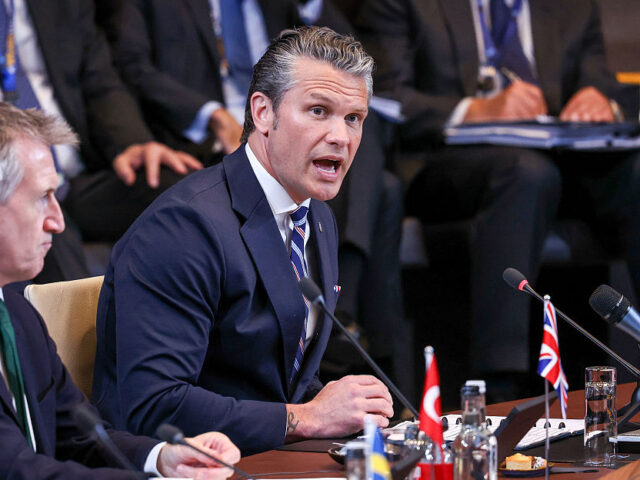
Secretary of War Pete Hegseth said the decline of European NATO as a warfighting organisation has mirrored the continent’s crisis of faith in itself and the open borders era, telling a meeting of alliance leaders they now need to step up if they want America to keep contributing.
A meeting of North Atlantic Treaty Organisation (NATO) member state defence ministers in Brussels, Belgium was addressed by U.S. Secretary of War Pete Hegseth on Thursday morning as a session opener, where he delivered a blunt assessment of the alliance’s failure to be war-ready, and warned it had six months to turn itself around or else face consequences.
Hegseth’s remarks spoke the language of “NATO 3.0” — also frequently mentioned by Secretary General Mark Rutte when discussing plans underway to transform the alliance — shorthand for the new standards members have to meet going forward. This third NATO is expressed as being a return to the first incarnation of the alliance, which won the Cold War and where its European members were major military powers, and as the end to NATO-two where Europe took full advantage of the so-called peace dividend to massively scale back defence and plough that money into other projects, most often welfare spending.
The Secretary of War was clear that his remarks would be blunt before he arrived in the chamber, characterising this in a huddle with press early Thursday morning that his day would be about being “candid”, adding “I think that’s important, friends being honest with friends”. Opening the joint session at NATO Headquarters, Hegseth made clear the old status-quo of NATO as a guarantee of European security with only minimum European involvement is “not going to cut it any more”, and said:
…as the Trump administration has said again and again in the last year and a half, our allies must step up. President Trump has been very clear on this point and over two administrations, and for too long NATO has been a paper tiger and a one way street. No more… transforming NATO back into a real military alliance that’s focussed on hard power and real deterrence… Europe was not supposed to be a dependency of the United States. That’s not what Winston Churchill or Charles de Gaulle or Konrad Adenauer wanted or expected.
The decline of NATO from what was founded by those post-war leaders has been mirrored in Europe’s broader deterioration and crisis of confidence in itself, he said. Hegseth cited the absurdity of a military alliance focussed not on warfighting but on “gender equity and climate change” and a civil Europe that threw its borders wide open to all-comers, permitting what critics have called an invasion, and the creation of welfare states that have exploded in size and now dominate national budgets ahead of all other spending. Hegseth remarked: “defence budgets cratered, along with Europe’s belief in itself and its civilisation. NATO lost its way… NATO 2.0 was an era of distraction, deindustrialisation, and demilitarisation. It was an era of freeriding, and those were lost years that we’re not going back to.”
It is time for NATO to become a “hard-edged warfighting organisation”, the Secretary said, and America was now watching to see which members are serious about the alliance are which are not, stating the involvement of the U.S. going forward would be tailored to those states which are standing up and shouldering a fair burden.
Hegseth warned many alliance members pitifully failed the first test — allowing U.S. jets and ships heading to the war in Iran to use bases in Europe on their way — and stated: “too many of our allies said no or tried to drown us in arcane legal debates, or criticised us publicly for doing what they aren’t prepared or able to do themselves. It was shameful”. This failure put American lives at risk, Hegseth said.
Europe was warned in the speech that it now has six months to show its NATO-member state nations are invested. Hegseth said:
…some countries have yet to show a credible path to meeting their Hague commitments, too much talk. Some of NATO’s largest economies, some of our richest countries, allies that are happiest to go on about the rules-based international order and middle powers banding together still seem to think the era of free-riding is here… it’s not going to cut it any more.
So we’re doubling down on our effort to make NATO what it was always supposed to be, a balanced alliance with Europe in the lead for its own defence. NATO 3.0. And to make that a reality I am announcing today a six-month Department of War review that will examine America’s force posture and basing in Europe, up to six months, could be less.
Let’s call it the NATO 3.0 review… we’re going to keep a close eye on allies that don’t [step up], and who say ‘no’, or ‘maybe’, or ‘wait and see’ when it matters most. It’s a review that some with fail, and others will pass with flying colours. In the end the review is intended to both improve U.S. force posture and basing, and strengthen NATO 3.0.
Hegseth appeared to make implicit that the U.S. would be reconsidering its deployment in Europe at the end of this six months and decisions would be based on which countries made solid guarantees on access to bases and overflight rights, and on which countries show that credible path to making their alliance spending commitments five per cent of GDP on defence investment.
As implied, this is a new floor to NATO spending to be reached by 2035 that only a handful of nations are credibly working towards. Indeed, half of the alliance remains stubbornly at the old spending floor of two-per-cent and seems unlikely to go anywhere. A defence spending crisis remains front-page news in the United Kingdom, which has just had two defence portfolio ministers resign over defence spending levels being so low and there being no prospect of improvement.
The UK has long been one of the key contributors to NATO and its sudden exposure as a delinquent has hit its global prestige hard, and seen it become a particular focus of the Trump White House which has told it to do better, to rediscover its old fighting spirit, and do so urgently.
NATO Secretary General Mark Rutte, who was picked for the role to be the best possible conduit between the alliance’s European members and President Trump, has long been a key part of the push to force European nations to realise that what Hegseth and Trump have called the freeloading era is over, with Rutte frequently talking encouragingly about European moves to backfill and become more responsible for their own defence. Speaking before today’s meeting, the Secretary General reflecting that “NATO 3.0 is really happening, a stronger Europe in a stronger NATO” and praised President Trump’s Iran deal for degrading Tehran’s nuclear and ballistic capabilities.
Welcoming Hegseth to Brussels, Rutte said today that in February last year he “gave a very strong speech about spending more… to make sure it’s a fair deal with the United States. You said ‘we’re committed to NATO’, but you also have an expectation that Europeans will at least equalise with what the U.S. is spending. And they had to, not only because you were asking, but also because we’ve got to keep ourselves safe”.
Rutte said: “we not only have to keep up, but we have to do better than Russia, China and others whoa re at this moment rapidly expending their defence industries”.
https://www.breitbart.com/europe/2026/06/18/hegseth-torches-paper-tiger-nato-you-have-six-months-to-shape-up/


No comments:
Post a Comment