The newly published lithium resource numbers are estimates, and much more work needs to be done to take advantage of our current mineral capacity
Back in February, I reported that the U.S. Geological Survey (USGS) estimated that 5 to 19 million tons of lithium are located in southwestern Arkansas. That is enough lithium to meet the world’s estimated 2030 demand for lithium nine times over.
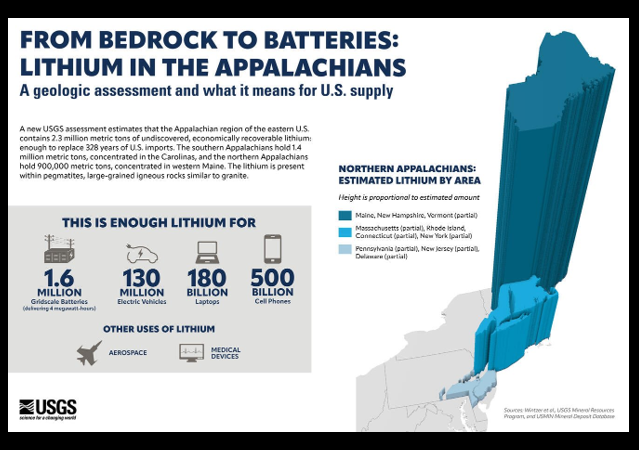
Now the USGS is saying that Appalachia contains an estimated 2.3 million metric tons of undiscovered, economically recoverable lithium, enough to replace 328 years of U.S. imports at last year’s level.
The southern Appalachians hold an estimated 1.43 million metric tons of lithium oxide, concentrated in the Carolinas, and the northern Appalachians hold an estimated 900,000 metric tons, concentrated in Maine and New Hampshire, according to estimates in a new USGS scientific paper published in Natural Resources Research. The lithium is present in pegmatites, large-grained rocks similar to granite.
“This research shows that the Appalachians contain enough lithium to help meet the nation’s growing needs – a major contribution to U.S. mineral security, at a time when global lithium demand is rising rapidly,” said USGS Director Ned Mamula. “USGS mineral science is the leading edge in the effort to restore America’s mineral independence by mapping our nation’s mineral resources. Everything else follows on the science: permitting reform and other policy changes to support investment in clean, responsible mining to 21st century standards, and mining workforce training for new American jobs. The United States was the dominant world producer of lithium three decades ago, and this research highlights the abundant potential to reclaim our mineral independence.”
The United States had one sole producer of lithium and relied on imports for more than half the lithium used last year, factors that contributed to its inclusion on the 2025 List of Critical Minerals published by the USGS. Lithium is used in the lithium-ion batteries that power computers, military equipment, vehicles, phones, electric tools, and energy-grid storage, as well as in aerospace alloys. Additional lithium is imported into the United States every year inside finished products made elsewhere and containing lithium-ion batteries. While Australia is the world’s largest producer of lithium, China is second, and accounts for the majority of world lithium refining and consumption.
@USGS has found that the Appalachian region of the U.S. contains enough lithium to replace 328 YEARS of imports!
Thanks to world-leading mineral science, permitting reform and renewed investment in domestic mining, @POTUS has reclaimed America's mineral independence. pic.twitter.com/INis76fW6o
— Secretary Doug Burgum (@SecretaryBurgum) April 28, 2026
The country currently operates just one full-scale lithium mine, Albemarle’s Silver Peak facility in Nevada, and this forces domestic automakers and battery producers to depend on imports for over half of their supply. As I have noted before, this situation becomes problematic when a foreign supplier becomes hostile.
As lithium demand is projected to grow more than 48-fold by 2040, driven by electric vehicles and energy storage technologies, securing new domestic sources has become increasingly critical.
USDS Director Ned Mamula notes that the US was the dominant world producer of lithium three decades ago. The newly published lithium resource estimates are preliminary, and much more work is needed to fully realize our current mineral capacity.
To quantify the region’s potential, USGS geologists compiled geologic maps, geochemical data, geophysical surveys, and records of known mineral occurrences. These inputs were combined with global datasets on lithium-bearing pegmatites to model the number and size of undiscovered deposits across the Appalachian belt, which stretches roughly 1,500 miles from Alabama to Maine.
The resulting assessment provides a probabilistic estimate, with a 50% likelihood that the region contains about 2.3 million metric tons of lithium oxide. Actual resources could be higher or lower, and further exploration will be required to determine the extent and economic viability of individual deposits.
The work is part of USGS’s ongoing mandate to assess domestic mineral resources and improve understanding of critical mineral supply potential in the U.S.
“USGS mineral science is the leading edge in the effort to restore America’s mineral independence by mapping our nation’s mineral resources,” said Mamula. “Everything else follows on the science: permitting reform and other policy changes to support investment in clean, responsible mining to 21st century standards, and mining workforce training for new American jobs.”
America is sitting on a lithium bonanza, from Arkansas brines to Appalachian pegmatites, but those world‑class reserves will mean little if Washington, D.C., and eco-activist bureaucrats keep strangling responsible mining with red tape.
We need to use this report as an opportunity to restore real mineral independence at home and end our dangerous reliance on Beijing for “white gold.”
https://legalinsurrection.com/2026/05/appalachia-lithium-cache-could-power-u-s-for-centuries/


No comments:
Post a Comment