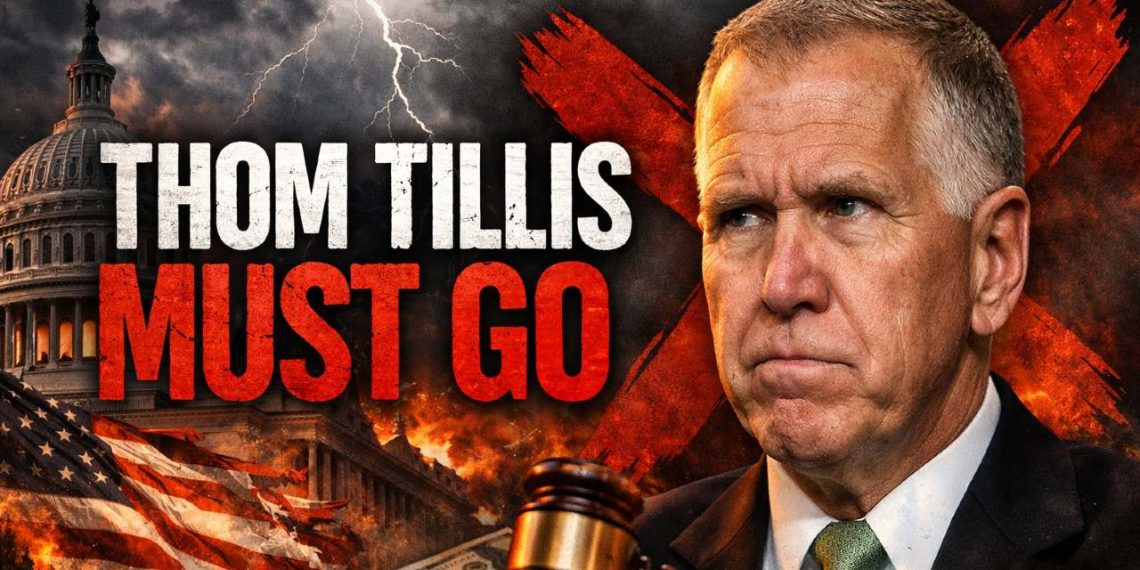
- Senator Thom Tillis has publicly declared he will block any attorney general nominee who fails his personal “red line” on January 6, effectively holding the Trump administration’s justice agenda hostage.
- As a senior member of the Senate Judiciary Committee, Tillis wields outsized influence over confirmations for judges, prosecutors, and top law-enforcement officials at the precise moment the Department of Justice must be restored to impartiality.
- His previous veto of Ed Martin as U.S. attorney for the District of Columbia—solely because Martin defended January 6 defendants—demonstrates a pattern of prioritizing a partisan narrative over the president’s constitutional authority.
- Senate committee assignments are controlled by each party’s conference; the Republican leadership can reassign Tillis immediately through the Conference or steering committee without needing a full floor vote.
- Because Tillis has already announced his retirement at the end of this Congress, removal carries minimal long-term electoral fallout for him and clears the path for a more reliable conservative replacement on the committee.
- Potential blowback includes predictable media hysteria labeling the move a “purge,” but the real risk of inaction is continued obstruction of nominees essential to ending the weaponization of federal law enforcement.
- Party discipline on key committees is not radical; it is standard practice when a member repeatedly places personal ideology above the mandate voters delivered in 2024.
- Removing Tillis would send an unmistakable signal: the Senate GOP will not tolerate internal roadblocks to the restoration of equal justice under law.
The Senate Judiciary Committee stands as the gatekeeper for the most urgent task facing the nation: reclaiming the Department of Justice from years of politicized abuse. Yet one Republican senator has drawn a line in the sand that has nothing to do with qualifications, competence, or constitutional fidelity. Senator Thom Tillis of North Carolina has announced he will oppose any nominee for attorney general who fails to meet his personal threshold on January 6.
That stance is not principled independence. It is an ideological veto that threatens to paralyze the very committee charged with confirming the officials who will finally hold the administrative state accountable.
Tillis’s ultimatum is idiotic. He will not vote to advance any successor to Pam Bondi if the candidate has ever “excused the events of January the 6th.” The same senator who helped sink Ed Martin’s nomination for U.S. attorney in the District of Columbia—explicitly because Martin had represented defendants charged after the Capitol protest—now signals he intends to repeat the performance on the highest law-enforcement post in the land. This is not mere skepticism of one candidate. It is a preemptive disqualification of an entire category of potential nominees based on their willingness to challenge the dominant media-Democratic narrative.
It’s a narrative that nobody outside of legacy media, Democrat politicians, and Thom Tillis takes into consideration anymore. It’s long dead as a topic of discussion and it was dumb even when it was being discussed.
Consider the constitutional stakes. Article II vests the executive power in the president, including the authority to appoint officers with the advice and consent of the Senate. Advice and consent has never meant that individual senators may substitute their own policy views, or in this case their own historical interpretations, for the president’s judgment.
The Framers designed the Senate to provide sober review, not to function as a star chamber enforcing one man’s version of a contested event. When a committee member treats January 6 as an unassailable sacrament rather than 5-year-old event that occurred amid a bitterly disputed election, he has stepped outside the bounds of legitimate oversight.
Tillis’s record on this issue reveals more than a single policy disagreement. He has consistently elevated the January 6 narrative above the broader pattern of selective prosecution that Americans witnessed for years. While federal agencies pursued parents at school boards and pro-life demonstrators with vigor, the same institutions treated the Capitol breach as an existential threat requiring maximum prosecutorial force.
Reasonable observers can acknowledge illegal activities occurred that day without endorsing the subsequent years of overcharging, solitary confinement, and selective amnesia about left-wing riots that caused billions in damage and dozens of deaths. Tillis refuses that distinction. In doing so, he aligns himself with the very institutional forces the electorate rejected in 2024.
The mechanics of removal are straightforward. Senate committee assignments are not granted by divine right or floor vote; they are allocated and adjusted by each party’s internal processes. The Republican Conference, guided by the Majority Leader and the Committee on Committees, determines membership. Precedent exists for reassigning members whose positions threaten party priorities. Because Tillis has already declared he will not seek re-election in 2026, the political cost of such a reassignment is negligible. A lame-duck senator clinging to a committee seat he plans to vacate anyway should not be permitted to obstruct the agenda voters demanded.
Critics will howl that removing Tillis constitutes a “purge” of moderates. The irony is rich. The same voices who cheered when Democrats stripped Republicans of committee assignments over policy differences now clutch pearls at the prospect of the GOP exercising basic internal discipline. The media’s selective outrage exposes the double standard: institutional norms are sacred only when they constrain conservatives. When those norms enable a senator to thwart the democratic will, they suddenly become flexible.
The practical consequences of leaving Tillis in place are more serious than any short-term media storm. The Judiciary Committee operates on a narrow 12-10 Republican margin. A single unreliable vote can stall entire slates of nominees. With acting officials already filling critical roles and the clock ticking on restoring impartial justice, delay is not neutral. Every week Tillis retains his seat is another week the administrative state retains its unaccountable power.
Nor should anyone pretend Tillis’s position reflects some deeper constitutional wisdom. He has spent recent months clashing with the administration over immigration enforcement, FEMA funding, and Federal Reserve nominations. The pattern is consistent: a senator who once positioned himself as a pragmatic deal-maker has become a reliable obstacle to the very reforms that delivered Republican majorities. Voters did not send a 53-47 Senate to Washington so that one member could relitigate January 6 at the expense of border security, economic recovery, and judicial appointments.
Some will argue for patience, suggesting Tillis might soften once a nominee is named. History offers no comfort. He has already demonstrated willingness to kill nominations on this exact issue. Waiting for him to change course is an invitation to further paralysis. The time for decisive action is now, while the Republican Conference still controls the calendar and the narrative.
Removing Tillis would not punish dissent; it would enforce accountability. It would affirm that the Senate Republican majority exists to advance the agenda voters chose, not to indulge personal litmus tests that echo the very media narratives the public has grown to distrust. The Judiciary Committee’s work is too important, and the moment too consequential, to allow one senator’s obsession with January 6 to stand in the way.
The American people have waited long enough for equal justice. They did not elect Donald Trump and a Republican Senate to watch internal obstructionists replay the same exhausted debates from 2021. Leadership in the Senate must act, and act swiftly. Thom Tillis’s removal from the Judiciary Committee is not a radical step. It is the bare minimum required to honor the mandate of 2024.
https://conservativeplaylist.com/why-thom-tillis-should-be-immediately-removed-from-the-senate-judiciary-committee/


No comments:
Post a Comment