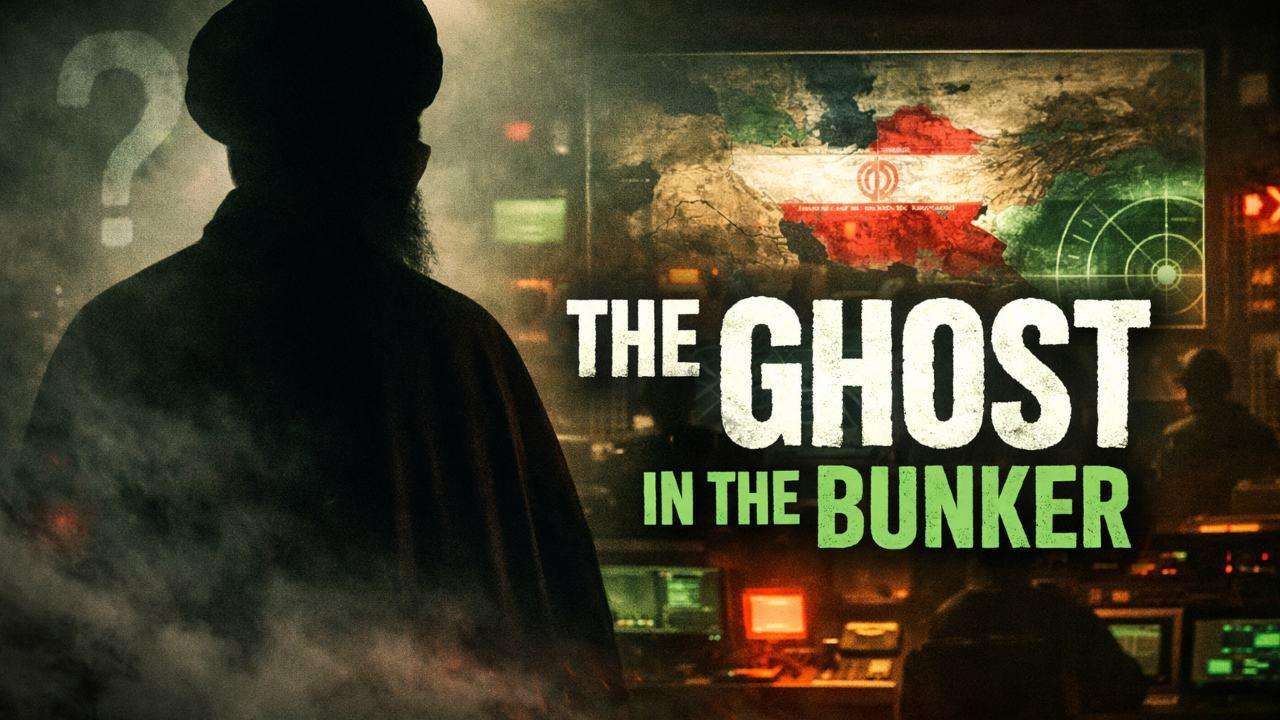
When Ali Khamenei was killed in the opening hours of Operation Epic Fury on February 28, 2026, the Islamic Republic lost the man who had held its contradictions together through sheer force of will for thirty-six years. What Iran gained in his place may be something stranger than a successor — it may be a symbol, a myth, or depending on how dark your reading of current events runs, something far more ominous.
His son, Mojtaba Khamenei, was named Supreme Leader on March 8. Since that day, he has not been seen. Not on camera. Not in a photograph. Not in person at any public event, including the memorial for his own father. His “statements” have been read aloud by television anchors — not delivered by the man himself. The regime’s silence around its own leader has produced exactly the kind of vacuum that conspiracy theories are made for. And in this case, the theories are not entirely unreasonable.
What follows is an attempt to examine three competing explanations for Mojtaba Khamenei’s disappearance — ordered from most to least likely — with an honest accounting of what the evidence actually shows. None of these can be confirmed. That is precisely the problem. In a regime that governs by opacity, the absence of verifiable truth is not an accident. It is policy.
Ali Khamenei was killed on February 28, 2026, in a joint U.S.-Israeli airstrike on his compound in Tehran. Iranian state media confirmed his death in the early hours of March 1.
His son Mojtaba Khamenei was appointed Supreme Leader on March 8 by the Assembly of Experts, reportedly under heavy pressure from the Islamic Revolutionary Guard Corps (IRGC).
Mojtaba was wounded in the same strike that killed his father. Sources describe severe facial disfigurement and serious injuries to one or both legs, with one U.S. intelligence source suggesting he may have lost a leg.
Since his appointment, Mojtaba has issued no video, no audio, and no verified photograph. His communications have been written statements read on state television by news anchors.
U.S. Secretary of Defense Pete Hegseth stated publicly that Mojtaba is “wounded and likely disfigured,” and questioned why a leader with access to cameras refuses to use them.
A viral video purporting to show Mojtaba in a war room analyzing Israel’s Dimona nuclear facility was widely debunked as AI-generated propaganda, with AI detection tools putting the probability of synthetic generation above 71 percent.
Mojtaba Khamenei is described by former associates as “apocalypse-obsessed,” and some of his supporters within the IRGC believe he is the prophesied Khorasani — a messianic figure from Shia eschatology destined to pave the way for the return of the Mahdi.
Analysts warn the IRGC, not Mojtaba, is effectively making the strategic decisions during the ongoing war, raising serious questions about who actually commands Iran’s military.
Theory One: The IRGC Is Running the Show, and Mojtaba Is the Mask
This is the least dramatic of the three theories, which is one reason to take it seriously. The history of authoritarian regimes is filled with moments when a figurehead leader was kept visible — or made to appear visible — while a deeper power structure made the real decisions. Lenin spent his final years incapacitated while the Soviet apparatus ground forward. Kim Jong-il’s inner circle managed a transitional fog for months after his health deteriorated. The mechanics of autocracy do not require a functional autocrat. They require the appearance of one.
The Council on Foreign Relations said it plainly in the days after Ali Khamenei’s assassination: “Taking out Iranian Supreme Leader Ayatollah Ali Khamenei is not the same as regime change. The Islamic Revolutionary Guard Corps is the regime.”
That assessment now hangs over the question of Mojtaba’s fitness to lead with considerable weight. Multiple senior Iranian sources have told Reuters that Mojtaba “will be one voice but it will not be the decisive one,” and that the IRGC — the same force that pressured the Assembly of Experts into selecting him — has emerged as the dominant decision-making voice on strategic matters during the war. His first “statements” as Supreme Leader were not delivered by him at all. It was read by a news anchor, an arrangement that allowed the regime to invoke his authority without requiring his presence.
Secretary of Defense Pete Hegseth put the skepticism in plain terms. Mojtaba is “scared,” Hegseth said in a press briefing on March 13. “He’s injured. He’s on the run, and he lacks legitimacy.” Trump himself has publicly questioned whether anyone has actually seen Mojtaba, musing that the new leader might be dead. The White House’s posture — conducting ceasefire negotiations with Iran’s elected president Pezeshkian rather than with the Supreme Leader — suggests that Washington has already drawn its own conclusions about where functional authority actually resides in Tehran.
What this theory implies is not that Mojtaba is dead, but that a wounded, inexperienced, mid-ranking cleric who was propelled into the world’s most dangerous job by a military faction now serves primarily as a legitimizing symbol while the IRGC prosecutes a war in his name. That is not a conspiracy theory. It is a reasonable inference from observable facts.
Theory Two: He Is Alive, But the Regime Cannot Afford to Show You What He Looks Like
The most detailed picture of Mojtaba Khamenei’s current physical condition comes from three anonymous sources close to his inner circle who spoke to Reuters and whose accounts align with public statements by U.S. officials. His face was disfigured in the February 28 strike. He suffered serious injuries to one or both legs; one U.S. intelligence source said he is believed to have lost a leg. Iran’s own state television, in what amounted to an accidental admission, referred to Mojtaba using the Farsi word janbaz — a term specifically used for those badly wounded in war — after naming him Supreme Leader. The regime has provided no official statement on the extent of the injuries. But the word choice was telling.
The question is not whether Mojtaba is incapacitated. The sources close to him are insistent that he remains “mentally sharp” and is participating in meetings by audio conference. The question is whether the Islamic Republic — a system that derives its authority from the image of a divinely guided, supremely confident, spiritually formidable leader — can sustain that image when the man himself is faceless, voiceless, and physically broken. The answer may explain more about his absence than any injury does.
The strongman mythology is not incidental to how the Islamic Republic functions. It is load-bearing. Khomeini’s portrait still hangs beside his successor’s across Iran. The system is built on the idea of an unshakeable clerical authority appointed by God, not elected by men. A Supreme Leader who cannot walk, whose face was disfigured by American and Israeli bombs, who communicates through scripted text read by strangers on state television — that is not a man who inspires the revolutionary fervor the regime needs to keep fighting. It is a vulnerability. And the IRGC, which helped install him, knows it.
Sources close to his circle told Reuters that images of Mojtaba could be released within one or two months, and that a public appearance might follow — “when his health and the security situation allow.” That is a diplomatic way of acknowledging that neither condition has been met. The irony, if it can be called that, is that Mojtaba’s physical absence may be prolonging the war. Iranian society is already fractured. Ordinary Iranians celebrated in the streets when Ali Khamenei was confirmed dead. Chants of “death to Mojtaba” circulated on social media following his appointment. A regime that cannot show its own leader to its own people is a regime in a kind of undeclared crisis, no matter how loudly its military fires missiles.
Theory Three: The Wounded Leader, the AI Avatar, and the Shadow of Prophecy
This is the theory that requires the most careful handling, because it sits at the intersection of genuine Islamic eschatology, observable technology, and the documented belief system of Iran’s new Supreme Leader himself. It is the least likely of the three in any literal sense. It is not, however, invented from nothing.
Jaber Rajabi is an Iranian exile, former IRGC operative, and one-time study partner of Mojtaba Khamenei at the Qom Seminary. He has given numerous interviews since Mojtaba’s appointment, and his descriptions of the man are not the profile of a conventional politician. Mojtaba, Rajabi told The Atlantic, is “apocalypse-obsessed.” He believes there are milestones on the path to the end of the world, and that he himself “will have a special part in hastening humanity down that path.”
Rajabi described him as “a brilliant zealot, much more extreme and uncompromising than his father, and a uniquely dangerous potential successor” — and called him “more dangerous than 50 nuclear bombs.” He also recounted that Mojtaba reported a dream in which the patriarch Adam appeared to him and confirmed his identity as al-Sayyid al-Khorasani.
The Khorasani is a figure from Shia eschatological tradition — a leader from the historical region of Khorasan, in eastern Iran, who according to prophecy will raise black banners, wage war against Iran’s enemies, and march toward Jerusalem to pave the way for the return of the Mahdi, the Hidden Twelfth Imam. Mojtaba was born in Mashhad, in Khorasan. His supporters within the IRGC — where the apocalyptic doctrine of Mahdism has been a central element of ideological indoctrination since at least 2009 — have already referred to him as a “living martyr” for surviving the February 28 strikes, noting that surviving an enemy attack mirrors another detail of the Khorasani prophecy. His appointment was announced on laylat al-qadr, the Night of Power, one of the most sacred nights in the Islamic calendar. Whether this timing was deliberate or coincidental, Rajabi says Mojtaba used it to “grant himself a form of sanctity.”
Now consider what is already confirmed about the information environment surrounding his absence. A video circulated widely in early April purporting to show Mojtaba entering a military command center with coordinates to Israel’s Dimona nuclear facility displayed on a large screen. The clip garnered millions of views and was treated as breaking news by numerous outlets.
It was AI-generated. Fact-checkers confirmed unnatural lighting, blurred facial features, and glitch-like transitions. AI detection tools rated it at over 71 percent likely to be synthetic. No official Iranian account posted the video. Yet it spread globally and shaped public perception of a man that almost no one has actually seen. The Brookings Institution published an analysis noting that Iran has turned to “generative AI to accelerate its existing information warfare playbook,” and that a coordinated deepfake campaign with synchronized posting windows had been traced to the Iranian regime.
Here is where the third theory emerges — not as prediction, but as a pattern worth watching. A Supreme Leader who cannot show his face. A regime that has already deployed AI imagery of that leader for propaganda purposes. A belief system in which Mojtaba sees himself as a prophesied messianic precursor. And an eschatological tradition that anticipates a great leader who will announce the return of the Mahdi and lead armies to Jerusalem. The technology to construct a convincing, speaking, commanding digital avatar of Mojtaba Khamenei exists today. The ideological motivation to do so — to present a “miraculously healed” or divinely transfigured Supreme Leader who then positions himself as the fulfillment of ancient prophecy — is not foreign to the worldview of the men around him. It is native to it.
Scripture long anticipated the appeal of signs and wonders as instruments of deception. “For there shall arise false Christs, and false prophets, and shall shew great signs and wonders; insomuch that, if it were possible, they shall deceive the very elect,” warned the Lord in Matthew 24:24.
The technology of our moment has simply given that ancient warning a new vector. An AI avatar of a disfigured Supreme Leader, deployed to announce himself as the forerunner of the Mahdi to hundreds of millions of Shia Muslims, would not require a miracle. It would only require a camera, a render farm, and a population already prepared to believe.
This is the theory that requires the most careful handling, because it sits at the intersection of genuine Islamic eschatology, observable technology, and the documented belief system of Iran’s new Supreme Leader himself. It is the least likely of the three in any literal sense. It is not, however, invented from nothing.
Jaber Rajabi is an Iranian exile, former IRGC operative, and one-time study partner of Mojtaba Khamenei at the Qom Seminary. He has given numerous interviews since Mojtaba’s appointment, and his descriptions of the man are not the profile of a conventional politician. Mojtaba, Rajabi told The Atlantic, is “apocalypse-obsessed.” He believes there are milestones on the path to the end of the world, and that he himself “will have a special part in hastening humanity down that path.”
Rajabi described him as “a brilliant zealot, much more extreme and uncompromising than his father, and a uniquely dangerous potential successor” — and called him “more dangerous than 50 nuclear bombs.” He also recounted that Mojtaba reported a dream in which the patriarch Adam appeared to him and confirmed his identity as al-Sayyid al-Khorasani.
The Khorasani is a figure from Shia eschatological tradition — a leader from the historical region of Khorasan, in eastern Iran, who according to prophecy will raise black banners, wage war against Iran’s enemies, and march toward Jerusalem to pave the way for the return of the Mahdi, the Hidden Twelfth Imam. Mojtaba was born in Mashhad, in Khorasan. His supporters within the IRGC — where the apocalyptic doctrine of Mahdism has been a central element of ideological indoctrination since at least 2009 — have already referred to him as a “living martyr” for surviving the February 28 strikes, noting that surviving an enemy attack mirrors another detail of the Khorasani prophecy. His appointment was announced on laylat al-qadr, the Night of Power, one of the most sacred nights in the Islamic calendar. Whether this timing was deliberate or coincidental, Rajabi says Mojtaba used it to “grant himself a form of sanctity.”
Now consider what is already confirmed about the information environment surrounding his absence. A video circulated widely in early April purporting to show Mojtaba entering a military command center with coordinates to Israel’s Dimona nuclear facility displayed on a large screen. The clip garnered millions of views and was treated as breaking news by numerous outlets.
It was AI-generated. Fact-checkers confirmed unnatural lighting, blurred facial features, and glitch-like transitions. AI detection tools rated it at over 71 percent likely to be synthetic. No official Iranian account posted the video. Yet it spread globally and shaped public perception of a man that almost no one has actually seen. The Brookings Institution published an analysis noting that Iran has turned to “generative AI to accelerate its existing information warfare playbook,” and that a coordinated deepfake campaign with synchronized posting windows had been traced to the Iranian regime.
Here is where the third theory emerges — not as prediction, but as a pattern worth watching. A Supreme Leader who cannot show his face. A regime that has already deployed AI imagery of that leader for propaganda purposes. A belief system in which Mojtaba sees himself as a prophesied messianic precursor. And an eschatological tradition that anticipates a great leader who will announce the return of the Mahdi and lead armies to Jerusalem. The technology to construct a convincing, speaking, commanding digital avatar of Mojtaba Khamenei exists today. The ideological motivation to do so — to present a “miraculously healed” or divinely transfigured Supreme Leader who then positions himself as the fulfillment of ancient prophecy — is not foreign to the worldview of the men around him. It is native to it.
Scripture long anticipated the appeal of signs and wonders as instruments of deception. “For there shall arise false Christs, and false prophets, and shall shew great signs and wonders; insomuch that, if it were possible, they shall deceive the very elect,” warned the Lord in Matthew 24:24.
The technology of our moment has simply given that ancient warning a new vector. An AI avatar of a disfigured Supreme Leader, deployed to announce himself as the forerunner of the Mahdi to hundreds of millions of Shia Muslims, would not require a miracle. It would only require a camera, a render farm, and a population already prepared to believe.
What the Silence Actually Tells Us
Taken together, these three theories are not mutually exclusive. The IRGC may be making the strategic decisions while the regime uses Mojtaba’s name as cover — and the reason his name can be used rather than his face is precisely because his face cannot be shown. And the deepest strand of his own belief system may be guiding the propaganda strategy that will eventually be used to re-present him to the world in a form the regime finds acceptable, which may not be the form reality left him in.
What is not a theory is this: Iran is being led by a man that no one outside a small circle of IRGC officers and medical personnel has seen since February 28. His communications are scripted and secondhand. His government is waging a war against the world’s most powerful military alliance in his name. And the ideology driving the men around him is one in which apocalyptic war is not a failure of statesmanship but a sacrament — a required milestone on the path to the end of the world. Whether Mojtaba is a puppet, a patient, or something darker is a question the regime will not answer. The silence itself is the answer that matters most.
Taken together, these three theories are not mutually exclusive. The IRGC may be making the strategic decisions while the regime uses Mojtaba’s name as cover — and the reason his name can be used rather than his face is precisely because his face cannot be shown. And the deepest strand of his own belief system may be guiding the propaganda strategy that will eventually be used to re-present him to the world in a form the regime finds acceptable, which may not be the form reality left him in.
What is not a theory is this: Iran is being led by a man that no one outside a small circle of IRGC officers and medical personnel has seen since February 28. His communications are scripted and secondhand. His government is waging a war against the world’s most powerful military alliance in his name. And the ideology driving the men around him is one in which apocalyptic war is not a failure of statesmanship but a sacrament — a required milestone on the path to the end of the world. Whether Mojtaba is a puppet, a patient, or something darker is a question the regime will not answer. The silence itself is the answer that matters most.



No comments:
Post a Comment