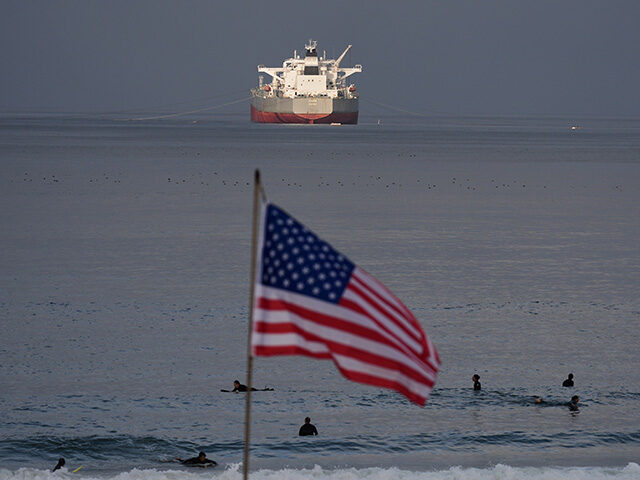
American multinational energy corporation Chevron is now importing an average of 250,000 barrels of Venezuelan crude oil per day into the United States, the BBC reported Tuesday.
According to recent reports, Venezuela’s monthly crude oil exports have once again surpassed one million barrels per day. Andy Walz – president of downstream, midstream, and chemicals at Chevron – confirmed to the BBC that the company is importing the equivalent a quarter of a million barrels of Venezuelan oil per day. The BBC detailed that the crude oil tanker Minerva Gloria recently docked at a wharf in the Mississippi sound, carrying 400,000 barrels of crude oil — an amount that, six months ago, would have been “impossible” to bring to the United States.
WATCH — President Trump: Running Venezuela Is America First:
Following the January 3 U.S. law enforcement operation in Caracas authorized by President Donald Trump that resulted in the arrest of socialist dictator Nicolás Maduro, the Venezuelan regime, now under “acting president” Delcy Rodríguez, has begun collaborating with the U.S.
Venezuela is home to the largest proven oil reserves in the world, but its oil output capacity has been dramatically diminished after more than two decades of disastrous socialist mismanagement left the nation’s entire oil industry in a dire state. Following Maduro’s capture, the Venezuelan socialists have sought American help and investment to restore the nation’s oil industry, which at some point was capable of producing upwards of 3 million barrels per day.

A demonstrator holds an effigy of former Venezuela President Nicolas Maduro outside Manhattan federal court before a pre-trial hearing in Maduro’s drug trafficking case, Thursday, March 26, 2026, in New York.
The BBC noted that Chevron and other companies are importing Venezuelan crude oil “by the shipload” as a result of the war in Iran and the Iranian regime’s blocking of the Strait of Hormuz.
“It’s a big deal not only for Chevron but the entire Gulf region,” Tim Potter, director of Chevron’s refinery in Pascagoula, Mississippi, told the BBC.
“It’s a pretty big incentive for us to run it,” he continued. “The refinery was really designed, and we invested in the refinery, to run heavy oils like from Venezuela.”
While Venezuela holds the world’s largest proven oil reserves, its extra-heavy crude is known to be thick, dense, and high in sulphur. As such, it requires extra processing for it to yield diesel, gasoline, jet fuel, and other oil products. The Guardian noted in January that this type of extra-heavy crude is “precisely” what some U.S. refineries were built to treat.
Per the BBC, there are 132 refineries in the U.S. that run on a mix of crude oils, with nearly 70 percent of America’s refining capacity running most efficiently with heavier crude. As the U.S. imports a minimal amount of oil from the Middle East, an increase in Venezuelan oil imports will translate to a larger availability in the U.S., which the BBC noted should translate into cheaper gas prices. According to the BBC, only eight percent of the oil imported by the U.S. came from the Middle East.
“We think we can take that up another 50 percent so call it somewhere around 350,000 to 400,000 barrels a day of just the Chevron share of our position in Venezuela,” Walz said.
The Chevron representatives emphasized to the BBC that the company believes importing Venezuelan crude oil will end up benefiting customers, noting that the “Iran war is just currently masking the gains.”
“When things do get back to normal, that additional supply out of Venezuela will actually translate to lower prices for Americans. So it will in the future, but it isn’t having an impact now,” Walz told the BBC.
“While we’re able to still get crude available here to this refinery because of our relatively local supply, the overall pricing of that crude has gone up because it’s based off of world markets,” Potter explained.
Chevron is presently the only U.S. company in Venezuela capable of extracting crude oil, allowing it to process it itself and get it directly to the U.S. consumer. Over the past weeks, the United States has issued general licenses to a small group of companies allowing them to purchase Venezuelan oil directly from the state-owned oil company PDVSA through a process that involves strict U.S. oversight and without violating existing oil sanctions. Proceeds from the sales remain under U.S. control through bank accounts managed by the Treasury Department.
Reuters reported on Monday that India’s Reliance Industries, one of the few companies that has received one such general license from the United States, has begun loading a cargo of 2-million barrels of Venezuelan crude oil directly bought from PDVSA at Venezuela’s main oil port, the José terminal in the state of Anzoátegui.
https://www.breitbart.com/latin-america/2026/04/08/report-chevron-importing-250000-barrels-of-venezuelan-oil-per-day/


No comments:
Post a Comment