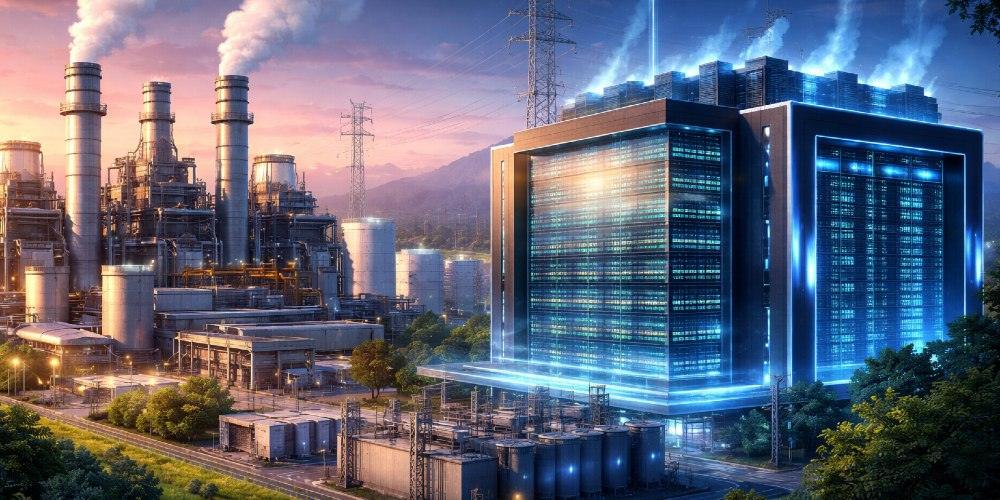
The explosive growth of AI is driving unprecedented electricity demand from data centers, which already consume around 4-5% of U.S. power and could reach 9-17% by 2030.
A new debate has emerged: whether massive AI facilities should plug into the existing power grid or operate as self-sufficient “energy islands” with on-site generation.
Roughly 30% of planned data center power capacity is now expected to come from on-site sources, a sharp rise from nearly zero a year ago, with some analysts projecting it could climb to 50%.
Speed is the decisive factor—grid interconnection queues can take years, while private developers can build dedicated natural gas plants or other generation next to facilities in months.
Proponents of islanding argue it shields residential ratepayers from cost increases and delivers faster deployment critical to America’s AI competitiveness.
Critics warn that widespread decoupling could raise long-term AI costs, require overbuilding for reliability, and weaken the broader grid by forgoing shared infrastructure benefits.
Industry voices, utilities, and regulators are clashing at forums like CERAWeek, with some hyperscalers open to eventual grid ties and others prepared to run independently for years.
The outcome will shape electricity bills for American families, national AI leadership, and the future reliability of the U.S. power system.
The artificial intelligence revolution is no longer confined to silicon chips and algorithms. It is now colliding head-on with the physical realities of American energy infrastructure. As tech giants race to train and deploy ever-larger models, the electricity required to power the necessary data centers has surged to the point where it rivals the consumption of entire cities. This demand is forcing a fundamental choice: integrate these power-hungry facilities into the nation’s aging grid or let them forge ahead as independent energy islands.
Data centers have long been significant electricity users, but the AI boom has changed the equation dramatically. Current estimates place their share of U.S. electricity at approximately 4-5%, with projections from the Electric Power Research Institute suggesting they could account for as much as 17% by the end of the decade under aggressive growth scenarios.
A single large AI-focused facility can draw continuous power equivalent to tens or even hundreds of thousands of households. The International Energy Agency and other analysts foresee global data center consumption exceeding 1,000 terawatt-hours by 2026 in high-growth cases—more electricity than some entire nations use today.
Against this backdrop, a high-stakes debate is unfolding over how best to supply that power. According to a February report from Cleanview, about 30% of planned data center capacity is now slated for on-site generation, up sharply from virtually nothing the previous year. Founder Michael Thomas sees the trend line pointing even higher, potentially toward 50% of planned capacity. Developers cite years-long delays in securing grid connections as the primary driver. Private companies can site a natural gas plant or other dedicated generation directly beside a data center and bring it online far faster than waiting for utility approvals and transmission upgrades.
Cully Cavness, president and co-founder of data center developer Crusoe, put the calculus plainly: “For us, speed is the competitive currency.” He noted that islanded facilities can be engineered to operate independently for meaningful periods—potentially years—until or unless grid connections become viable. Rob Wingo of Williams echoed the practical appeal, pointing out that on-site power not only accelerates deployment but also avoids placing immediate additional burden on retail customers served by the broader grid.
Examples are already materializing. Chevron is advancing a deal to construct a dedicated natural gas plant to serve a Microsoft data center in Texas. Federal regulators at the Federal Energy Regulatory Commission have ordered rule changes for pairing data centers with power plants, reflecting the national scope of the challenge. FERC Chairman Laura Swett acknowledged the agility gap: regulators “cannot move as deftly as a private corporation who can build power right next to where they need it.” Yet she emphasized ongoing efforts to streamline interconnection processes.
Not everyone views islanding as the optimal path. Varun Sivaram of EmeraldAI warned that decoupling the AI ecosystem from the electric grid would leave both sides worse off: AI becomes more expensive while the power sector loses its largest new anchor customer. Google’s Amanda Peterson Corio highlighted a key drawback—off-grid systems often require overbuilding to achieve comparable reliability, driving up costs. NextEra Energy CEO John Ketchum predicted that most hyperscalers will ultimately want an “extension cord” to the grid for its economic and backup advantages.
The tension reflects deeper questions about infrastructure, economics, and national priorities. America’s grid was designed for a different era of relatively stable, incremental demand. AI-driven load growth is concentrated, constant, and accelerating. Regional operators like PJM have warned of potential capacity shortfalls reaching tens of gigawatts in coming years, while ERCOT in Texas faces hundreds of gigawatts in large-load interconnection requests. Without swift additions of firm, dispatchable generation—whether natural gas, nuclear, or other reliable sources—the risk of higher costs, delays, or reliability issues rises.
Recent policy signals from the Trump administration have sought to address these pressures directly. Tech leaders have signed commitments to cover the incremental costs of new power generation for their facilities, aiming to protect residential ratepayers from bearing the burden. Such measures recognize that unchecked cost shifting could erode public support for the very innovation driving economic opportunity. At the same time, they underscore the urgency of expanding reliable baseload capacity rather than relying solely on intermittent sources ill-suited to 24/7 AI operations.
For communities hosting these projects, the stakes are tangible. Data centers can bring jobs, tax revenue, and economic development, yet they also raise legitimate concerns about local grid strain, water use for cooling, and potential impacts on electricity prices. When developers opt for on-site generation, they can mitigate some immediate effects on neighboring ratepayers while still contributing to broader energy infrastructure over time.
The path forward will likely involve a mix of approaches rather than a single solution. Some facilities may launch as islands and later interconnect. Others will pursue hybrid models or invest directly in grid upgrades. What remains clear is that artificial intelligence cannot advance at full throttle without confronting the energy realities that underpin it. America possesses abundant natural resources, engineering talent, and private-sector drive. Harnessing them wisely—through streamlined permitting, support for firm generation, and pragmatic partnerships—will determine whether the nation leads the AI era or watches its potential constrained by self-imposed bottlenecks.
The coming years will test the resilience and adaptability of U.S. energy systems. The AI boom has already rewritten assumptions about electricity demand. How policymakers, utilities, developers, and technologists respond will shape not only power bills and grid reliability but also the trajectory of American technological supremacy and economic strength for decades ahead.


No comments:
Post a Comment