We could stop this if we wanted to.
Hate crime hoaxes are nothing new, but during the “woke” overcorrection of the late teens and early 2020s, when Kendrick Lamar won a Pulitzer, Sports Illustrated put a man on the cover of a swimsuit issue, and everyone pretended to enjoy “Hamilton,” they reached heretofore unimaginable heights.
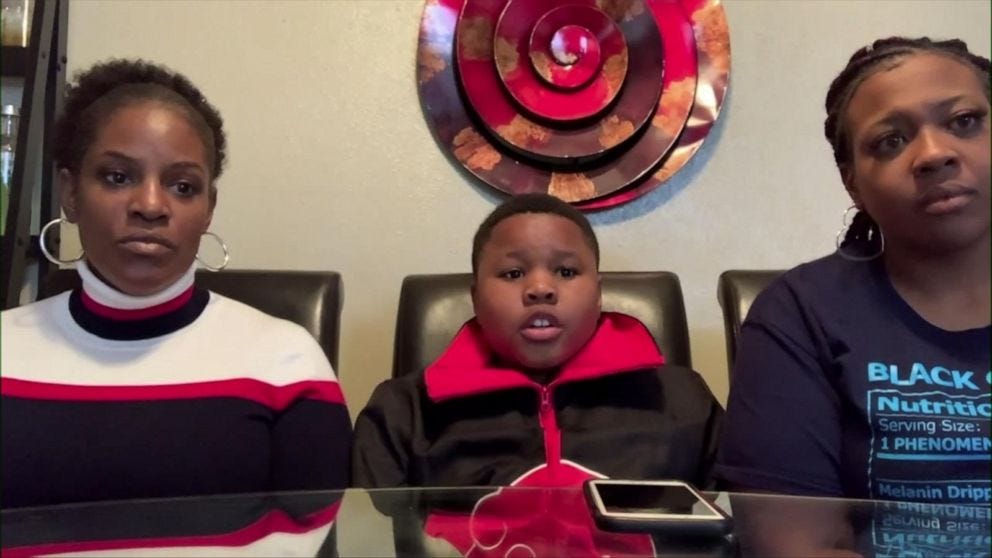
Consider the 2021 incident in Plano, Texas, where a white teenager, Asher Vann, was accused of “torturing” a black classmate, SeMarion Humphrey.
It was a shocking story, full of cruelty and racial animus.
It was also a total fiction.
Thanks for reading And another thing ...! Subscribe for free to receive new posts and support my work.
It was March 2021 when Humphrey’s mother, Summer Smith, alleged that Vann shot her son with BBs, slapped him, called him racial slurs, and even forced him to drink urine. ABC, NBC, CBS, CNN, and the Dallas Morning News were among the first to jump on the story, each eager to report on the supposed indignities suffered by a black teen at the hands of an evidently racist white Texan. A leader of a Black Lives Matter-affiliated group claimed that Humphrey had been “tortured for hours.” The NAACP organized marches. Vann was doxxed, and protesters gathered outside his home.
Smith, who described Vann as “evil,” made the rounds on the networks. Her attorney, Kim Cole, launched a GiveSendGo campaign “to help with the expenses of therapy and private schooling” for Humphrey. The campaign, featured on Good Morning America, raised an impressive $120,000.
This was five years ago.
On Jan. 22 of this year, a Texas district court judge ordered Smith and Cole to pay $3.2 million in damages to Vann. The decision followed a jury’s finding last year that the duo had fabricated the story and “intentionally inflicted severe emotional distress” on the young man.
As for the online donations, Humphrey’s mother bogarted them. Of the $120,000 raised, only $1,000 went towards her son’s schooling. Much of the rest was spent on luxury items, including “a designer dog, dining and travel, beauty products, liquor, vapes, cell phones, car payments, and rent,” according to a Washington Free Beacon review of account statements.
As for Vann, he’s now in college and moving on with his life, having spent the past five years weathering death threats and doxxing attempts.
Lastly, as for the media outlets that were so eager to promote the Humphrey hoax, none of them have published follow-up reports mentioning either the 2025 jury decision or the damages awarded by the Texas judge. Vann also told the Free Beacon that none of the news outlets that amplified Smith’s allegations ever contacted him for comment. Not even once.
The 2021 torture hoax story was, at the time, the most shocking racial hate crime allegation reported since 2019. That was when two white Trump supporters supposedly jumped actor Jussie Smollett in downtown Chicago at 2 a.m. in sub-zero temperatures. The actor claimed they doused him with bleach, put a noose around his neck, and shouted, “This is MAGA country!”
This, of course, never happened either. Smollett stage-managed the attack on himself, seemingly in a bizarre and ill-advised attempt to boost his personal image.
The most frustrating thing about these hate crime hoaxes, besides the media attention they attract, is that they persist precisely because we in the news business simply refuse to distinguish between believable and unbelievable, choosing instead to treat all such allegations with equal gravity and urgency.
This has created a target-rich environment for fraudsters.
An Arab American server in Odessa, Texas, claimed a customer stiffed him on a bill, writing on the receipt, “We don’t tip terrorist [sic].” He lied. A black waitress in Virginia reported that a customer left her a note saying, “Great service, don’t tip black people.” Clearly a lie. A gay waitress in New Jersey said her customers left her a note that read, “Sorry, I cannot tip because I do not agree with your lifestyle and the way you live your life.” She lied. A bisexual North Park University student claimed a stalker sent her homophobic notes and emails. She lied. A Muslim student at the University of Louisiana claimed that two white Trump supporters tore off her hijab and stole her wallet the day after the 2016 election. She lied. A lesbian couple in Colorado accused their neighbor of spray-painting “Kill the Gay” on their garage and placing a noose on their front door. They lied. A gay pastor claimed a cake decorator at a Whole Foods in Austin wrote “Love Wins Fag” on his dessert. It was a lie. David’s Episcopal Church in Bean Blossom, Indiana, was vandalized with a swastika and the words “Heil Trump” and “Fag Church.” The church’s organist, who is gay, did it. A black student at Viterbo University claimed she was targeted with harassment, including racist graffiti and messages, and an arson fire in her dorm. She wrote the notes and set the fire herself. During the 2023 Colorado Springs mayoral race, a trio of black activists, who supported the black candidate, “found” a burning cross and a campaign sign defaced with a racial slur on their front lawn. The supporters staged the supposed hate crime themselves.
In each case, the hate crime claim attracted extensive media coverage. Also, in many instances, the hoaxer wasn’t caught until after he or she had already collected a boatload of cash from online donations.
Journalists are supposed to think critically. We don’t have to bite on every story that comes our way, especially when the toplines are so immediately suspicious.
Decline, as people say more and more today, is a choice. Likewise, when it comes to uncritically parroting some of these hate crime stories and spreading moral panic, we all have a choice.


No comments:
Post a Comment