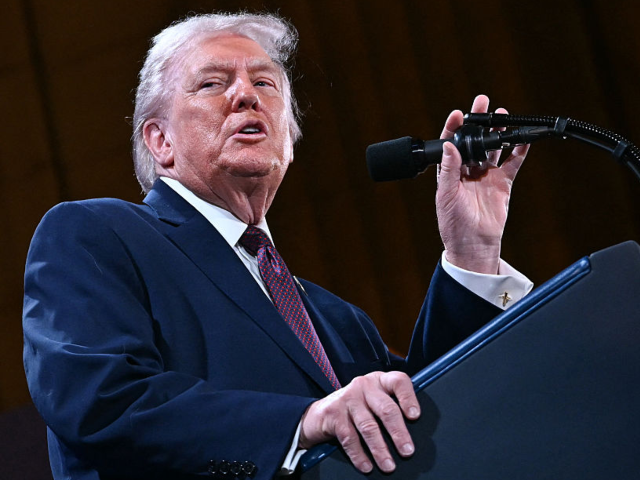
President Donald Trump warned Wednesday that “a massive armada” led by the aircraft carrier USS Abraham Lincoln is moving toward Iran and that the regime’s “time is running out” to make a nuclear deal — or face a U.S. strike far worse than the one carried out last summer.
Writing on Truth Social, Trump said the armada is “moving quickly, with great power, enthusiasm, and purpose,” describing it as a larger fleet than the force previously sent to Venezuela and one “ready, willing, and able to rapidly fulfill its mission, with speed and violence, if necessary.”
Trump urged Tehran to “come to the table” and negotiate a deal, warning that time is “truly of the essence,” and making clear that failure to do so would bring severe consequences.
The warning explicitly referenced past military action. Trump said Iran ignored an earlier demand to make a deal, which was followed by “Operation Midnight Hammer,” adding that “the next attack will be far worse.”
Operation Midnight Hammer refers to the June 22, 2025 U.S. strikes at the end of the 12-day war, when B-2 bombers dropped 12 GBU-57 Massive Ordnance Penetrators — bunker-buster bombs — on Iran’s Fordow nuclear facility, while a U.S. submarine fired 30 Tomahawk missiles at the Natanz and Isfahan nuclear sites.
Iran’s mission to the United Nations responded within hours on its official X account, invoking past U.S. wars and claiming Washington “squandered over $7 trillion and lost more than 7,000 American lives” in Afghanistan and Iraq.
The statement said Iran was open to dialogue based on “mutual respect and interests,” but warned that if pushed, the regime would defend itself and “respond like never before.”
The exchange comes as Washington backs its warnings with visible military deployments. On Monday, U.S. Central Command said the Abraham Lincoln and its carrier strike group entered the Middle East “to promote regional security and stability.”
Regional tensions have been further complicated by reports Tuesday that Saudi Arabia will not allow U.S. forces to use its airspace or territory for an attack on Iran, echoing a similar position taken by the United Arab Emirates a day earlier.
Iran has simultaneously escalated its rhetoric. Over the weekend, Gen. Mohammad Pakpour, commander of Iran’s Islamic Revolutionary Guard Corps, said Iran and the IRGC stand “more ready than ever, finger on the trigger,” to execute orders from the regime’s leadership.
Diplomatic signals from Tehran have been mixed. While Iranian officials have claimed communication channels remain open, Iranian Foreign Minister Abbas Araghchi said Wednesday there had been no recent contact with U.S. envoy Steve Witkoff, though intermediaries were holding consultations.
Writing on X later Wednesday afternoon, Abbas Araghchi struck a defiant tone, declaring that Iran’s “brave Armed Forces are prepared — with their fingers on the trigger — to immediately and powerfully respond to ANY aggression against our beloved land, air, and sea,” while claiming the regime had learned “valuable lessons” from the 12-day war that would enable a faster and more forceful response.
Araghchi simultaneously insisted Tehran remains open to what he described as a “mutually beneficial, fair and equitable” nuclear deal, asserting that Iran seeks only “peaceful nuclear technology” and has “never sought to acquire” nuclear weapons — language that echoed long-standing regime denials even as military threats intensified.
The warning from Washington comes as U.S. intelligence assessments describe Iran’s ruling Islamic regime as being at its weakest point since the 1979 revolution, citing internal dissent, economic collapse, and deepening instability that has shaken the regime’s grip on power.
That weakness has coincided with an intensifying crackdown. Reporting published Sunday described a two-day massacre that may have killed more than 36,000 Iranians, including accounts of wounded civilians executed in hospitals, victims stuffed alive into body bags, and mass arrests carried out under near-total internet blackouts.
As unrest has spread, senior Iranian officials have turned their fire outward. Last week, Iran’s judiciary declared it would “pursue” and “punish” President Trump through domestic and international channels, accusing Washington and Israel of fomenting regime unrest and backing “terrorists.”
Iranian President Masoud Pezeshkian has likewise blamed the United States for Iran’s crises, warning that any move against Supreme Leader Ali Khamenei would amount to an “all-out war” even as the regime faces growing unrest driven by economic collapse and years of political repression.
Amid the mounting pressure, Khamenei has reportedly relocated to a fortified underground bunker network in Tehran — a move underscoring the regime’s fear as Washington pairs military force with economic pressure and intelligence assessments pointing to unprecedented internal weakness.
Trump’s message left Tehran little room for miscalculation: Make a deal — or face consequences far more devastating than before.
https://www.breitbart.com/politics/2026/01/28/trump-warns-iran-make-nuclear-deal-or-face-far-worse-attack-as-massive-armada-nears-time-is-running-out/



No comments:
Post a Comment