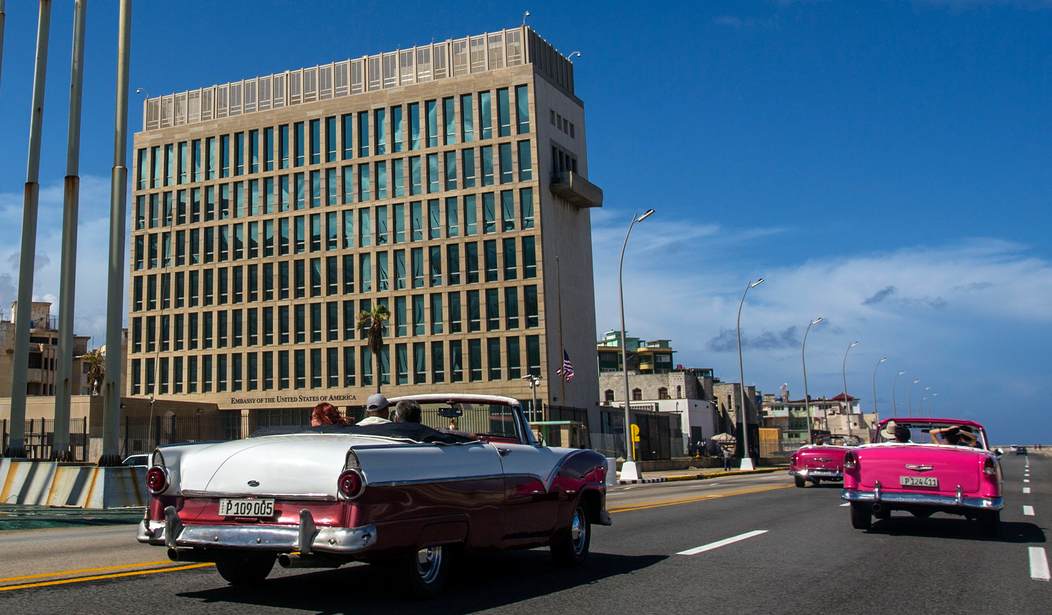
Cuba's communist leadership is talking very tough about its willingness to fight to the last man. Over the weekend the country announced plans for a "state of war."
The Cuban national defence council said it had approved “plans and measures” to declare a “state of war” to be enacted in the country, state media reported on Sunday.
No details were given as to how this would be implemented, but the press release said the measures would be based on the concept of “war of all the people”, a strategy promoted in the 1980s under the country’s former leader Fidel Castro as the allied Soviet Union was collapsing.
The policy, which makes up the foundation of the Cuban military doctrine, dictates that civilians are incorporated into the war effort in the face of possible aggression.
Juan Carlos Marson, Cuba's a leader of the country's communist party also seems to be planning for an attack. "If Cuba is provoked, the United States knows very well what will follow. We will not tolerate an attack on our country the way Venezuela was attacked. Ours is a nation forged through sacrifice and struggle. No one can intimidate us," he said.
There's just one problem with all of this tough talk. No one seems to be planning an attack on Cuba that would require ever man woman and child to fight to the death. On the contrary, President Trump seems to assume that Cuba will collapse on its own without any help from the US military. And there's good reason to think he's right about that. Venezuela was Cuba's energy lifeline but that lifeline has been shut down now. The NY Times published another article about the bad state Cuba is in now.
Cuba needs 100,000 barrels of oil a day to keep the lights on, experts say, and to keep its buses, trains and factories running.
But because of President Trump, it is not getting nearly enough.
With the Trump administration exerting control over Venezuela’s oil industry, Cuba is receiving only a trickle of the oil it needs — a shortage experts warn is increasingly likely to trigger a humanitarian crisis unlike any the country has ever experienced.
From diesel to operate buses to gasoline for cars to jet fuel to power airplanes, oil is in short supply in Cuba.
So what happens next? Well, absent some dramatic change, what seems likely to happen next are nationwide blackouts, economic collapse and popular unrest. That last one is something the government has cracked down on many times in the past.
A sustained oil shortage that triggers multiple hardships will almost certainly stir discontent in the country of nine million people and place new pressure on a government that has struggled to address the country’s longstanding economic challenges.
The government has responded harshly to popular unrest in the past. During the last wave of huge street demonstrations, in 2021, which was motivated by human rights abuses and pandemic-related economic problems, the government detained more than 1,400 people, according to human rights groups.
In fact, some Cubans worry that's what the "state of war" is really about.
Alina Bárbara López Hernández, a Cuban historian and prominent activist, questioned whether the measures would lead to a suspension of constitutional guarantees.
Others expressed concerns that it could lead to greater abuses by the police to suppress protests over the economic crisis.
Declaring war is a handy way to also declare that any opposition to the government is an act of treason. That might turn out to be handy when the lights go out and the autocratic government is dealing with millions of unhappy people demanding change and a better future than the one 67 years of communism has delivered.
https://hotair.com/john-s-2/2026/01/20/cuba-declares-a-state-of-war-as-the-country-runs-out-of-time-n3811057


No comments:
Post a Comment