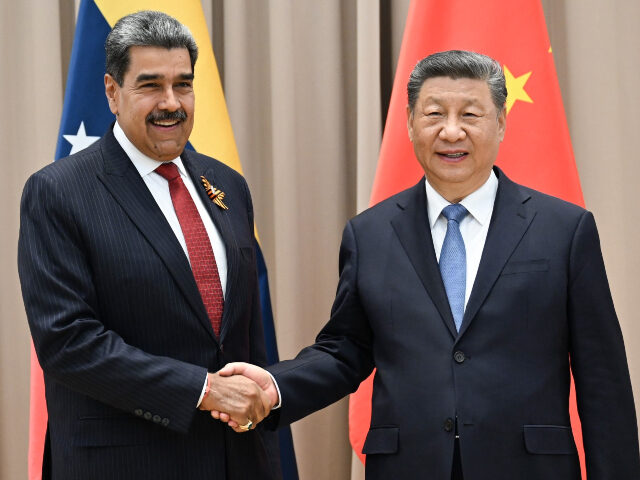
Chinese officials are reportedly seeking assurances from Venezuelan and American officials that China’s massive loans to Venezuela will be protected after the fall of Nicolas Maduro, the brutal narco-terrorist dictator Beijing supported.
“The cooperation between China and Venezuela is the cooperation between two sovereign states, which is under protection of international law and the domestic laws of the two countries. China will take all necessary measures to protect its legitimate rights and interests in Venezuela,” a spokesman for the Chinese embassy to the United States said in an email to the media on Wednesday.
Bloomberg News noted that Maduro’s regime stopped releasing public data on its debts after it missed payments on the international bonds for its state oil company, PDVSA, and went into sovereign default in 2017.
“Estimates range widely, with analysts putting outstanding obligations anywhere from $10 billion to $20 billion. China is expected to insist on a seat at the table in any future debt restructuring involving Venezuela,” Bloomberg News said.
Reuters quoted some much higher figures last week: about $60 billion in defaulted bonds, plus “external debt including PDVSA obligations, bilateral loans and arbitration awards.”
“The International Monetary Fund estimates Venezuela’s nominal GDP at about $82.8 billion for 2025, implying a debt-to-GDP ratio of between 180%-200%,” Reuters noted.
China propped Maduro up with a “loans for oil” scheme that allowed the dictator to borrow huge sums from Chinese banks and repay the debt with deeply discounted crude oil shipments. Chinese lending trailed off as the Maduro regime floundered, and Venezuela’s ability to produce crude oil diminished. The effective outstanding balance of these loans is anyone’s guess.
Maduro arrogantly refused opportunities to renegotiate his debts, because he did not want to compromise his dictatorial authority by working with the national legislature. Some of his schemes for delaying the inevitable fiscal apocalypse were flatly unconstitutional and illegal, so unraveling the tangled finances of the barely-functional government he left behind will be a massive undertaking.
The Economist last week observed that the “astoundingly messy” pile of bad paper Maduro left behind is actually catnip for high-stakes financial gamblers, because “nearly a decade in default has made Venezuelan debt ultra-cheap, and the prospect of recovering even a few cents on the dollar is enough to excite investors.”
Cleaning up that mess will involve dealing with three major groups of creditors: private bondholders, foreign oil companies that saw their assets stolen by Maduro’s predecessor Hugo Chavez in the 2000s, and China. The Chinese could be worried that President Donald Trump will prioritize the claims of American oil companies above their own.
Conversely, the Atlantic Council worried on Wednesday that China could use its “secured creditor status and operational leverage over Venezuela’s petroleum sector” to block debt restructuring efforts.
The Atlantic Council advised the International Monetary Fund (IMF) to “impose program conditionality that prevents preferential treatment of powerful creditors, particularly China.”
“Under traditional IMF rules, Beijing could until recently effectively veto a Venezuelan program by refusing to provide upfront restructuring commitments and, instead, engaging in multiyear negotiations that would leave the country in limbo while economic conditions deteriorate further,” the Council noted.
The proposed solution was for Venezuela’s post-Maduro government to invite China to join in debt-restructuring talks with other creditors on equal footing as the best way to fairly safeguard China’s legitimate interests.
If Beijing refuses, the United States could invoke the IMF’s recently-reformed Lending Into Official Arrears (LIOA) policies to strip China of its extra leverage by making Venezuela “contractually bound not to provide official holdout creditors better treatment than bondholders and other creditors receive.” China’s oil-for-debt scheme would be specifically blocked by the LIOA’s provisions.
https://www.breitbart.com/national-security/2026/01/16/china-reportedly-demanding-venezuela-honor-its-debts/


No comments:
Post a Comment