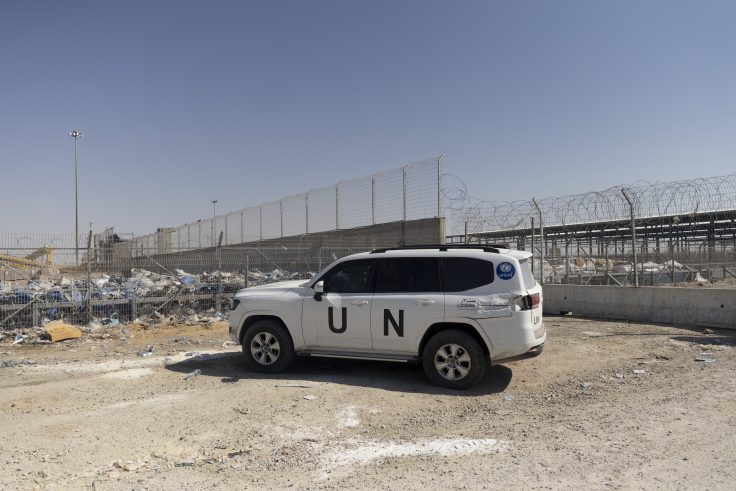
RAFAH, GAZA STRIP—Every day this week, hundreds of U.N. trucks stacked with pallets of humanitarian aid have exited Israeli-patrolled routes and rumbled into population centers across the Gaza Strip, where Israel has implemented daily pauses in military operations.
Many of the trucks, though traveling under enhanced Israeli protections introduced on Sunday, have not reached U.N. warehouses, according to Gazans on the ground. Once the trucks have arrived in the population centers, armed Hamas militants have hijacked the cargo, the Gazans said, and what aid has arrived at the warehouses has disappeared into a patronage system controlled by Hamas.
Most Gazans have been forced to buy the aid at exorbitant prices from merchants handpicked and heavily taxed by Hamas.
"Fifty trucks arrived yesterday at warehouses in Gaza City, and Hamas stole all of the aid," Moumen al-Natour, a 30-year-old lawyer in the northern Gaza capital, said on Tuesday. "Today, the aid went on sale in the black markets at very high prices."
Al-Natour said a childhood friend, seeking to feed his family, joined a hungry mob trying to loot the trucks and was trampled to death along with a number of other civilians.
Gazans and Israeli military officers say this has been the reality in Gaza since fighting resumed in March. Hamas exerts near-total control over U.N.-led aid operations and seizes nearly all the incoming goods to feed and finance its terrorist regime, according to the people. Rather than confront the problem, U.N. officials have effectively aligned with Hamas, prolonging the war and the suffering of Gazans, the people say.
"Hamas has unfortunately been able to infiltrate the mechanism of the United Nations for a long time," said Al-Natour. "They take all the aid for their own people and leave nothing for the civilians. This is how they maintain their criminal government even as their popularity has collapsed."
Al-Nator said Hamas has arrested him more than 20 times for organizing the We Want To Live protests and repeatedly tortured him.
U.N. officials, echoed by international media and world leaders, have long accused Israel of causing mass hunger and death in Gaza, saying Israeli authorities have prevented aid trucks from moving freely into and around the strip. Those condemnations have continued in recents days, even as the number of U.N. trucks entering Gaza’s population centers has surged.
The Gazans and Israeli officers told a different story, one in which the United Nations and Hamas share overlapping operations and interests in Gaza, belying U.N. claims to be neutral.
"We’ve seen it with our own eyes and intelligence," said a high-ranking Israeli officer involved in strategic planning. "The U.N. aid is being stolen by Hamas. It is making this war longer and making the situation worse for the people of Gaza."
"I don’t know if the United Nations and Hamas are exactly working together, but they’re working for the same purpose—and actually for the same reasons. They both want control and money," he said.
"We know there’s an element of infiltration in these international organizations. We’ve seen it very clearly. There’s also the element of so-called protection money, where Hamas gets money or food from the organizations and what it gives them in return is protection, as in, 'We won’t kill you,' or, 'Your operations will remain safe.'"
Most of the dozens of people who spoke to the Washington Free Beacon in the course of this reporting asked to remain anonymous, the Israeli military officers to discuss politically sensitive information and the Gazans for fear Hamas would kill them.
How Hamas Controls the U.N. System
The Israeli military on Tuesday released footage that military officers said showed armed Hamas operatives looting an aid truck last week. A high-ranking Israeli military officer involved in coordinating U.N.-led aid distribution in Gaza said Hamas militants in the past several weeks have hijacked several U.N. convoys.
In each case, according to the officer, the militants intercepted convoys just south of the Israeli military-controlled buffer zone in northern Gaza and stole about 40 percent of the cargo. The militants redirected trucks carrying that amount of aid to warehouses run by affiliates and let the rest of the convoy continue to U.N warehouses, he said. This has been standard practice for Hamas when it comes to hijackings.
Eli Meiri, an Israeli reserve colonel whose armored battalion has specialized in securing aid distribution during the war, estimated that Hamas and affiliated gangs have lately hijacked about half of arriving aid trucks en route to U.N. warehouses. Gazans gave similar or higher estimates.
"Hamas doesn’t want to be seen stealing all the U.N. aid from its own people, so it just hijacks half the aid," Meiri explained. "But it gets the other half of the aid in other ways."
Hamas has managed much of its theft of aid not by attacking the U.N. system but instead by exploiting and even protecting it. Nearly all U.N. employees in Gaza are locals who live under Hamas’s sway. According to Israeli intelligence, at least 12 percent of the employees are members of Hamas or other terrorist groups.
Among the U.N. employees identified by Israel as Hamas terrorists were a number of drivers of aid trucks. Many have coordinated their shipments with Hamas in return for protection and a cut of the cargo, according to Saed, a Gazan researcher who has investigated the U.N. aid system and said Hamas has arrested him four times because of him work.
"The drivers of these trucks alert Hamas before they enter with the aid," Saed said. "They hand over a portion to Hamas and also take some for themselves and their people."
Once the aid trucks have reached U.N. warehouses, U.N. employees and Gazan government officials who belong to or work with Hamas have taken control of the aid, according to several Gazans and Israeli military officers.
"Many trucks arrive at the warehouses, but all the aid that goes inside disappears," Saed said.
"Hamas has control of the warehouses because these are its people inside," said Meiri.
After Israel lifted a 10-week blockade of Gaza in May, the military began sending aid trucks on routes through northern Gaza where civilians might be more likely to succeed in hijackings, three high-ranking Israeli military officers said. The military did not deny the practice and declined to comment on whether it has continued this week.
Earlier in the war, the United Nations and Gaza’s Hamas-run Ministry of Social Development distributed some basic food aid to civilians at shelters, schools, mosques, and other sites, according to several Gazans. But since the latest ceasefire collapsed in March, aid distribution has all but ended, they said, confirming U.N. assessments, and any goods that Hamas has not allocated to its members and loyalists it has sold via local merchants at ever-increasing prices.
"When you go to the market, you see the aid that was supposed to be delivered to the people for sale," Saed said. "If you ask a trader where he got this food from, he will tell you the name of someone from Hamas or whose family works with Hamas."
Mohammad, a 35-year-old graphic designer from Jabalya in northern Gaza, said, "If you’re not Hamas, you can’t get anything."
Gazans reported paying steep fees to Hamas-employed cash agents to buy pilfered aid. With Gaza’s economy and banking system largely destroyed by the war—making it nearly impossible for civilians to withdraw cash—the agents, most of them teenage boys, have accepted digital transfers to Hamas-linked bank accounts in exchange for bills, charging a 45 percent fee, several Gazans said.
Al-Natour said he has paid about $150 a day for food and roughly $135 to cash agents to provide a single modest meal for his family of 10 each day, rapidly drawing down savings he accumulated before the war.
"We haven’t eaten meat since the ceasefire," he said. "Our bodies are growing thin. We are struggling to survive."
As Israel has continued a campaign of airdrops of food, daily pauses in military activity, and expanded routes for aid trucks, Israeli prime minister Benjamin Netanyahu has characterized the measures as a way of calling the United Nations’ bluff.
"The U.N. has no excuses left," he said in English-language remarks on Monday. "Stop lying. Stop finding excuses. Do what you have to do."
A Tinted Window
U.N. officials have insisted there is no proof that Hamas systematically diverts aid.
Eri Kaneko, a spokesman for the U.N. Office for the Coordination of Humanitarian Affairs, said in a statement, "Our humanitarian operations are structured to ensure that when enabled and facilitated, aid reaches those who need it—and only them."
Kaneko acknowledged that since Israel lifted the blockade, most aid trucks have been looted before reaching U.N. warehouses. But he attributed the looting to "people desperate to feed their families, adding, "This is what happens when aid is not allowed to enter at the scale and speed necessary to meet the needs of civilians across Gaza."
In a statement, U.N. Relief and Works Agency called allegations that Hamas diverts aid a "pretext to justify the aid distribution system" launched in southern Gaza three months ago by Israel in partnership with the Gaza Humanitarian Foundation, an upstart American aid organization, "which falls far from abiding to the humanitarian principles and international humanitarian law."
International news outlets, including the New York Times, have played up the notion that Hamas’s routine theft of aid is in doubt. That has only been possible because Israel has largely barred journalists from entering Gaza, noting it is a dangerous active war zone, and because Hamas fulsomely polices the flow of information out of the strip, several Gazans said.
They said Gazan freelance journalists and photographers are either affiliated with or influenced by Hamas. So are interviewees. And when outlets like the Times and Washington Post reference the Gaza Health Ministry and its death tolls, they are, of course, referencing Hamas.
The Times last week published a front-page story under the headline "Gazans Are Dying of Starvation." The main photo shows an emaciated child alongside the caption: "Mohammed Zakaria al-Mutaqaq, about 18 months, with his mother, Hedaya al-Mutawaq, who said he was born healthy but recently diagnosed with severe malnutrition." Mohammed was not born healthy—he suffers from cerebral palsy—and a photo the Times did not publish appears to show his 3-year-old brother in good health.
The Times on Wednesday addressed that information in a vague editors' note—released via its communications account on X, which has less than 100,000 followers, rather than its main account, which boasts more than 50 million—that acknowledged Mohammed has "pre-existing health problems, without elaborating. None of the Times journalists credited with writing the article reported from Gaza; only Saher Alghorra, who provided its images, worked on the ground in the strip.
Some mainstream U.S. coverage has painted a different picture, albeit with caveats. A Washington Post piece published last week quoted Gazans who recounted Hamas schemes to divert aid, extort local merchants, and kill those who refuse to cooperate. At the same time, it quoted a U.N. World Food Programme official who said "that systematic aid diversion by Hamas 'has not been an issue for us so far in this conflict.'"
https://freebeacon.com/israel/how-the-neutral-un-is-helping-hamas-oppress-gazans-and-fool-the-world/


No comments:
Post a Comment