Friday, August 21, 2026

NY Knicks Owner Turns Against Kathy Hochul, Gives Big to Republican Opponent

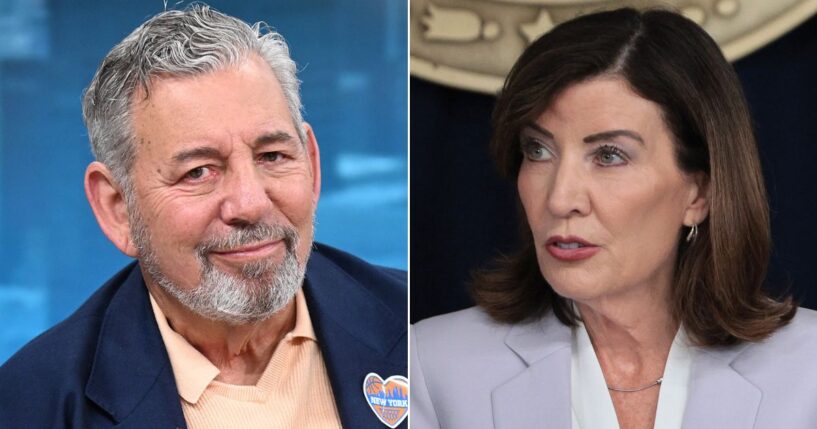
Billionaire James Dolan, left, owner of the NBA champion New York Knicks, is pouring millions into the campaign for Republican Bruce Blakeman, who is running to replace Democratic New York Gov. Kathy Hochul, right.

New York Democrats have driven one of the state’s major donors into the arms of Republicans.

According to Politico, billionaire James Dolan, owner of the NBA champion New York Knicks, has spearheaded an effort to pour millions of dollars into Republican Bruce Blakeman’s gubernatorial campaign.

In 2022, Dolan backed Blakeman’s opponent, Democratic Gov. Kathy Hochul.

Now, in conjunction with his company and with family members, Dolan has given so much money to pro-Blakeman committees and super PACs that he stands as New York state’s single largest GOP donor.

New York Conservative Party Chair Jerry Kassar offered one explanation for the billionaire’s apparent shift.

“Historically he’s leaned toward Republicans, but he hasn’t always been about Republicans,” Kassar said of Dolan. “He’s been about what’s best for his business interests.”

At present, Dolan’s business interests include keeping Madison Square Garden intact. The billionaire owns the legendary arena. He also owns the two teams that call the Garden home: the Knicks and the NHL’s New York Rangers.

Meanwhile, New York City’s iconic Penn Station, which sits directly below the Garden, will soon receive an $8 billion overhaul. Construction will begin by the end of 2027 and continue for six years, per PBS.

Over the years, some Penn Station renovation proposals called for relocating Madison Square Garden. With the backing of President Donald Trump, however, the current project will proceed while leaving Dolan’s arena in place.

According to Politico, Dolan met with Trump at the White House earlier this year. Trump later told the New York Post that he preferred not to relocate Madison Square Garden.

But Dolan’s frustration with New York’s ruling Democrats goes beyond the Penn Station renovation project.

In 2023, for instance, the New York State Liquor Authority threatened to revoke Madison Square Garden’s liquor license after Dolan installed cameras and facial-recognition software to prevent his perceived adversaries from attending events there.

“This gangster-like governmental organization has finally run up against an entity that won’t cower in the face of their outrageous abuses,” the billionaire said at the time. “While others that have been subject to this harassment may have been forced into submission or silence, we are taking a stand on behalf of our fans and the many small businesses who have long been subject to the SLA’s corruption.”

Dolan has also feuded with Democratic Mayor Zohran Mamdani of New York City, Politico reported. The socialist mayor has made no secret of his desire to tax the rich.

From the GOP perspective, Dolan’s contributions could have nationwide consequences. After all, if Blakeman runs a competitive race against Hochul, down-ballot Republicans will benefit. That includes Republicans in U.S. House swing districts, of which New York boasts several.

Thus, a strong showing from Blakeman, backed by Dolan, could help the GOP maintain control of Congress.

In June, the Knicks defeated the San Antonio Spurs, 4-1, to win the NBA title. Shortly thereafter, Dolan announced that his team would become the first NBA champion to visit Trump’s White House.

Amid the excitement of New York’s 2026 playoff run, Hochul falsely insinuated that Trump qualified as a Johnny-come-lately Knicks fan. Footage of Trump attending a 1994 NBA Finals game at Madison Square Garden, however, proved the governor wrong.

https://www.westernjournal.com/ny-knicks-owner-turns-kathy-hochul-gives-big-republican-opponent/

BREAKING: Chief Justice Roberts Steps In At The Last Minute — Hands President Trump A HUGE Win

President Trump views construction of the White House ballroom

Chief Justice John Roberts just stepped into the White House ballroom battle, and President Trump scored the immediate win he needed.

Only hours before a court-ordered construction cutoff was set to take effect, Roberts temporarily blocked the injunction that would have stopped aboveground work on the $400 million project.

For now, the crews can keep building.

But this is a crucial distinction: Roberts has not issued a final ruling on the legality of the project. His order preserves the current situation while he or the full Supreme Court considers the Trump administration’s broader emergency request.

The breaking decision was announced Friday afternoon:

The Supreme Court’s official docket records the order in National Park Service v. National Trust for Historic Preservation.

Roberts stayed the preliminary injunction entered by the federal district court in Washington on April 16. The stay will remain in place until Roberts or the full Court issues another order.

That short language carries enormous practical weight. A divided federal appeals court had allowed the lower-court restriction to take effect on August 21, which would have forced the White House to stop the aboveground portion of the project.

Roberts acted after reviewing the administration’s application, the National Trust’s response and the government’s reply. The docket does not give his reasoning, and it does not set a deadline for the next Supreme Court action.

This is exactly the emergency relief the administration requested last week.

The Trump administration’s emergency application asked Roberts to stop the injunction from taking effect while the government seeks a longer stay and prepares a petition asking the Supreme Court to hear the case.

Solicitor General D. John Sauer argued that the injunction improperly interferes with the president’s authority over the White House complex.

The filing describes the ballroom as part of an integrated military and security project, not a stand-alone event space.

The administration says the larger complex includes hardened construction, secure gathering space and protection against modern threats. It argues that forcing work to stop would leave a massive open construction site beside the White House, increase costs and disrupt a design that is already well underway.

According to the filing, the project was about 65% complete when the emergency application reached the Supreme Court. The government also said crews were working 20 hours a day, seven days a week, with roughly $200 million already spent or committed.

The challengers see the case very differently.

The National Trust for Historic Preservation contends that President Trump cannot undertake a project of this scale without congressional approval. Lower courts agreed that aboveground construction should stop while the lawsuit proceeds, although underground security work was permitted to continue.

The Associated Press reported that Roberts issued a one-page temporary order just hours before the lower-court rulings would have forced the halt.

The project is planned as a roughly 90,000-square-foot addition where the East Wing once stood. President Trump has said the ballroom will be funded through private donations, including his own contribution, while the administration has increasingly emphasized the security features tied to the construction.

The preservation group accuses the White House of moving so quickly that it could finish much of the structure before the courts resolve whether the president had authority to proceed. The administration answers that a shutdown now would create its own security and logistical dangers.

Roberts’ order does not settle that constitutional fight.

It does, however, prevent the lower-court injunction from freezing the project at a critical moment.

That means the immediate deadline has passed with construction still authorized. The next move could come from Roberts alone or from the full nine-member Court.

President Trump promised that he would take this fight all the way to the Supreme Court.

On Friday, his administration got the last-minute lifeline it was seeking.

https://wltreport.com/2026/08/21/chief-justice-roberts-president-trump-white-house-ballroom-win/

Drug Gangs Bribe, Blackmail and Intimidate Mayors, Cops and Other Public Officials: French Prime Minister Lecornu

French Prime Minister Sébastien Lecornu 

France in danger of becoming a narco-state?

Sebastien Lecornu is the seventh French under the failed two-term presidency of Emmanuel Macron.

Lecornu is tasked with taking the outgoing government into this last stretch until next year’s Presidential elections, a vote that rightwing Marine Le Pen is fully expected to win.

But the Prime Minister has to at least appear to be doing something urgent and energetic, because the Republic is falling apart at the seams.

We have been reporting here on TGP about the absolute catastrophe that the unchecked mass migration has wrought upon France, from the imported rape culture to the stabbing epidemic – it’s all fraying the fabric of French society.

But what is perhaps not as well covered is the scourge of organized crime.

Yesterday (20), Lecornu warned his cabinet (and the nation) that drug gangs are bribing, blackmailing and intimidating mayors, police and other public officials.

Not that this is any news, but the announcement is to the effect that the PM has – finally – decided to focus his attention on the ongoing disaster.

The Telegraph reported:

“Sébastien Lecornu has told ministers to tighten controls on sensitive data and pursue disciplinary action whenever there is evidence of wrongdoing in the civil service. About 150 integrity breaches are detected each year, up 40 per cent in five years.

Mr. Lecornu warned: ‘Due to the growth of organized crime, government departments and state-run organizations are increasingly exposed to high risks of breaches of integrity, given the nature of their remit, their powers and their access to sensitive information or procedures’.”

7 years in, Lecornu fails to treat this criminality growth as an occurrence caused by the failings of the ruinous Macron government.

Unauthorized accesses to sensitive files have surged, Lecornu said.

“One brigadier-chief allegedly carried out at least 194 suspicious searches of police databases, including on figures linked to the powerful DZ Mafia, with investigators finding evidence suggesting searches were ordered for €500 (£435) each.”

The courts have also been targeted with illicit searches of sensitive judicial databases, with several officials already arrested.

But besides bribery, Lecornu also referred to ‘acts of intimidation’ and warned what everyone knows: France risks sliding towards a ‘narco-state’.

https://www.thegatewaypundit.com/2026/08/drug-gangs-bribe-blackmail-intimidate-mayors-cops-other/

A Chinese in Havana

Political systems leave their deepest marks not only on constitutions and speeches, but also on kitchens, shops, homes and human faces.


Cuba just marked the 100th anniversary of Fidel Castro’s birth. Since the 1960s, the communist island has occupied a special place in the imagination of the American left. Yet when I spent nine days there in 2024, I saw Cuba through two pairs of eyes: those of someone raised in Maoist China and those of someone who has lived in America for nearly four decades.

To many Western visitors, Havana means sunshine, beaches, cigars, rum, Latin music, and American cars from the 1950s. To me, it also resurrected the China of my childhood: nearly empty state stores, ration books, subdivided mansions, and daily life sustained by endless repairs and improvisation. I recognized the logic of scarcity because I had lived under a similar system.

Havana is undeniably beautiful. Its churches, arcades, balconies, and wrought-iron railings retain the elegance of the Spanish colonial era. Yet beauty and decay are inseparable. Plaster peels from walls, windows stand broken, and rubbish piles up in the streets. Houses once occupied by single families were redistributed after the revolution and divided among numerous households.

The sight reminded me of Guangzhou in the 1960s and 1970s. I grew up in an American-style house built with money my great-grandfather had earned as a railroad worker in the United States. By the time I was a child, nine families lived in it. Cuba resembled a chapter of my own life that China had since left behind.

Nothing felt more familiar than Cuba’s ration book. Families use it to obtain limited quantities of rice, cooking oil, and other necessities. A clerk weighs each portion while customers watch the scale closely, anxious not to lose even a little. Rationed goods are inexpensive, but the allotments are inadequate. The same products can cost many times more on the open market.

Cuba therefore contains several economies at once: the official wage economy, the ration system, the open market, and, above all, the dollar economy. A tourism worker who receives tips can easily earn more than a doctor, teacher, or engineer. Pay no longer reflects the value of work. Access to foreigners, hard currency, and scarce goods determines one’s real economic status.

The American embargo has imposed genuine costs, but it cannot explain everything. Cuba, once famous for sugar, now imports it. For decades, the Soviet Union bought Cuban sugar on favorable terms and supplied the island with oil, machinery, and aid. When the Soviet Union collapsed, the system collapsed with it. Abandoned mills and factories remain as monuments to a dependent command economy. A government cannot credit every success to the revolution while blaming every failure on foreigners.

Havana’s famous cars capture this contradiction perfectly. Chevrolets, Buicks, Fords, and Cadillacs share the streets with Soviet Ladas. They survived not because Cuba was wealthy enough to preserve them, but because Cubans could not buy replacements or obtain original parts. A single vehicle may combine an American body, a Soviet engine, and components from several countries. Cuban mechanics keep them alive through ingenuity and necessity. Tourists buy nostalgia; owners manage scarcity. Poverty, packaged for tourism, becomes scenery.

The young people idling on Havana’s streets reveal another kind of stagnation. Official unemployment may be low, but having a job is not the same as having a future. When salaries cannot support a dignified life and education brings little reward, young people turn to waiting, hustling, or leaving. A society does not need mass demonstrations to show that its youth have lost faith. Emigration is also a vote.

Against this fatigue stands the eternally young face of Che Guevara in Revolution Square. Western admirers wear his image as a symbol of freedom, often without asking about his role in revolutionary tribunals, executions, and repression. Once detached from its consequences, revolution becomes fashion. Guevara never has to queue for cooking oil or watch his apartment crumble. Reality ages; the icon does not.

My clearest lesson about the Cuban state came not from Revolution Square but from a police station. After I took photographs near the U.S. Embassy, plainclothes officers detained me for about three hours. Using translation software, I told one officer, “I am an American. This is my embassy. I only wanted to see what my money bought.”

He did not understand.

I tried again: “In America, we own our government.”

This time, he said he understood.

Before I was released, I was permitted to photograph a revolutionary poster on the wall—but not the room around it. That detail captured the logic of a controlled society. It does not reject the camera; it decides where the camera may point. The poster is meant to be seen. The room behind it is not.

The Cuba presented to foreign tour groups is similarly curated. Interestingly, several programs we visited were organized by gay and transgender groups. I quietly asked one organizer how the project was funded. He answered candidly that it received support from an American nongovernmental organization. Apparently, USAID money was also at work in Cuba.

Cuba is not China. China eventually undertook a vast market transformation. Ration coupons, foreign-exchange certificates, and empty shelves became history for most people. Cuba preserved much of the older system. Havana therefore conveys a sense of suspended time: the cars have aged, the buildings have aged, and the revolution has aged. Only the heroes remain young.

Two Cubas coexist. One belongs to visitors: rum, cigars, music, beaches, Hemingway, Guevara, and vintage cars. The other belongs to those who live there: wages, rationing, deteriorating housing, shortages, dollars, policing, and emigration.

In the gap between them, I repeatedly saw the China of my past. Political systems leave their deepest marks not only on constitutions and speeches but also on kitchens, shops, homes, and human faces. A revolution may change flags, slogans, and rulers. It cannot invoke its ideals forever to escape responsibility for its results.

https://amgreatness.com/2026/08/18/a-chinese-in-havana/

Nutball Lefty Broad Who Said PPD 'Actually IS' an Excuse to Kill Children MELTS DOWN When Called Out

You can understand that Postpartum Depression is a very real thing and still believe Lindsay Clancy should go to jail for murdering her three children.

It seems far too many women on the Left can't seem to separate the two thoughts.

Case in point:

He's right.

There is no excuse to murder your own children.

But ... well ... yeah. Enter the crazy:

It's not.

Not even a little bit.

BUT TRUMP.

Past time.

As you can imagine, this woman who you just know is a blast at birthday parties and family gatherings, did not react well when people held her accountable for saying there's any sort of excuse for murdering children.

Take a gander:

Still doesn't excuse murder.

Maybe she should read her own post. It's not very long or all that confusing.

Agreed. But that's not what she said.

Yes, it's somehow MAGA's fault she posted something stupid and refuses to own it was stupid. 

Totally.

Go with that.

https://twitchy.com/samj/2026/08/21/nutball-crazy-leftist-woman-who-said-postpartum-depression-is-excuse-to-kill-kids-n2431533

It's Cartoon/Meme Time! #494a