Things aren’t great for America, when the so-called Commander in Chief has trouble with basic tasks.
Joe Biden claimed he’d be a much better president than Donald Trump. Oh, really? What have we seen from him since January 20?
He was hiding for weeks, signed a mountain of executive orders, rejected his own promise for unity, and there was that time he fell on the stairs.
But that’s only the beginning. Americans will worry even more, after this video comes out.
From Western Journal:
As Biden warned Americans that the ongoing health crisis was “deadly serious,” he conspicuously stumbled over his words on too many occasions not to merit comment from a public already concerned about the commander-in-chief’s cognitive health.
In the span of just 53 seconds, he made a number of concerning errors that are impossible to ignore.
As usual, Joe Biden was hammering fear and gloom down a country’s throat, that has already been coming out of a devastating lockdown.
He tried to urge senior citizens to get the vaccine, while claiming his brand of fearmonger was about “politics.”
Then he dropped a whopper of an egg, claiming the last administration did “nothing” about the virus and even ignored it.
That’s all par for the course for Biden. But even more troubling was the fact he could barely get out the words he was clearly reading.
Dr. Anthony Fauci, the director of the National Institute of Allergy and Infectious Diseases and President Joe Biden's chief medical adviser, has beenmore than happy to speak his mindon a multitude of topics whenever he believes there might be even the most tangential coronavirus connection.
He has warned against going to holiday gatherings, attending sporting events, living life without face masks even if vaccinated, allowing maskless kids to play together, and anything else that tickles his fancy.
But he has been strangely silent about the current border crisis, where our Border Patrol is being overrun by thousands of illegal aliens surging into the U.S. The migrant crisis has raised COVID-19 questions in the minds of many observers.
How many of these illegals are positive for the virus? Is our government even bothering to test them? Have they released known COVID-positive migrants into the country?
It turns out that thousands of migrants have been released into the U.S. without evidence of ever having submitted to a COVID-19 test, the New York Post reported.
The U.S. Centers for Disease Control and Prevention even changed its COVID protocol guidelines to allow the Biden administration to house illegal immigrant children in shelters at 100% capacity — and more.
And at least one mayor of a U.S. border town has repeatedly sounded the alarm that the government was shipping illegals to his community and refusing to reveal the migrants' COVID-19 infection rates.
Yet Dr. Fauci has remained curiously quiet about all of this.
His silence has not gone unnoticed.
One of the leading voices calling out Fauci's refusal to call out the border crisis' COVID-19 threat is the man who served as chief of staff to former President Donald Trump.
Mark Meadows made his observation Wednesday afternoon on Twitter.
"There was no policy, medical or otherwise, that Dr. Fauci wouldn't weigh in on when President Trump was in the White House," Meadows wrote. "Curious we haven't heard from the same Dr. Fauci on Joe Biden releasing thousands of COVID untested migrants into the U.S."
Meadows isn't the only Fauci critic to note the good doctor's refusal to comment on the border situation.
Alabama Republican Rep. Mo Brooks and a number of other GOP lawmakers fired off a letter to Fauci on March 12 asking him to use his clout to stop "a dangerous new foreign pipeline for COVID-19" along the U.S.-Mexico border, AL.com reported.
The letter stated that Biden's "dangerous" policy of "catch-and-release" along the southern border has caused an uptick in illegal crossings, exposing "the lack of any uniform testing requirements or quarantine protocols — despite the fact that Mexico now has the highest per capita COVID fatality rate in Latin America."
"Even more troubling," the letter continued, "are recent reports indicating that the surge in illegal migration is worsening by the day, creating a dangerous new foreign pipeline for COVID-19 infections in border communities, and the nation at large."
Fauci, the lawmakers noted, is "in a unique position to make recommendations based on scientific evidence and data on what you believe to be best practices when it comes to containing the spread of the virus — something you have not hesitated to do on multiple occasions over the course of the last several months."
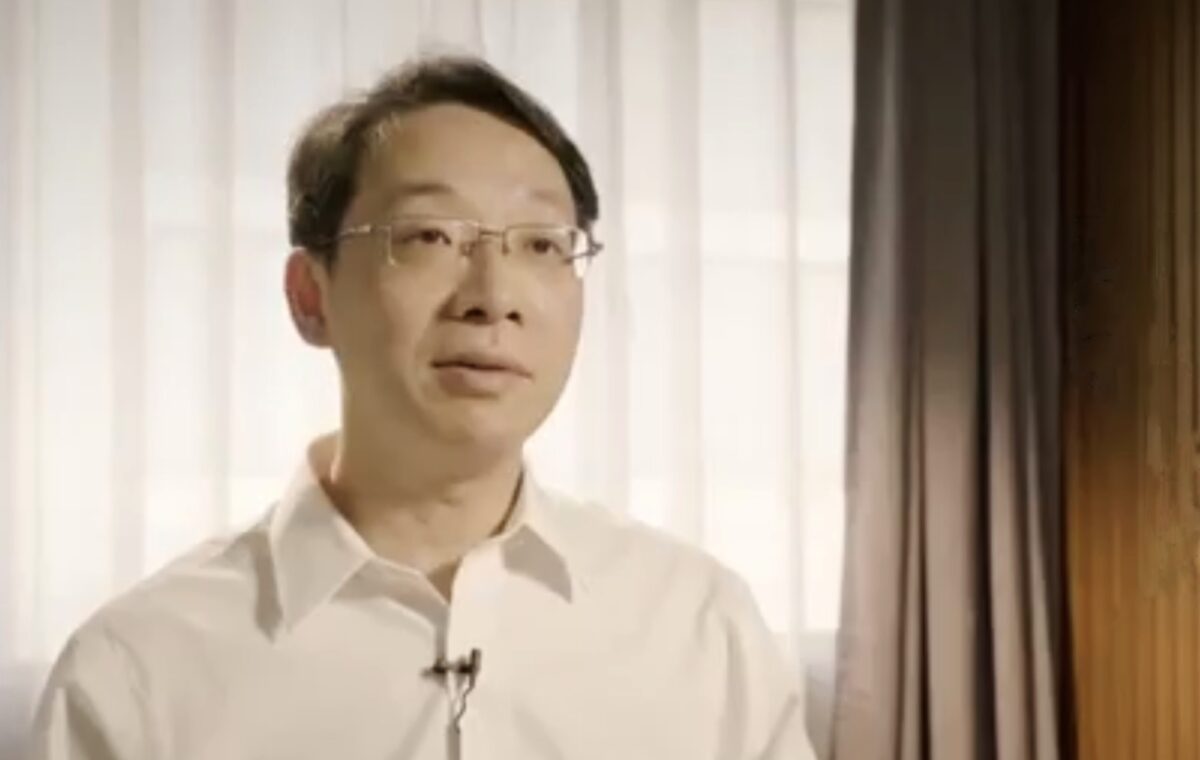
Di Dongsheng, associate dean of the School of International Studies at Renmin University in Beijing, talks about how to replace the U.S. dollar as the world reserve currency in Beijing, China on Dec. 28, 2020.
The Chinese regime is accelerating its efforts to challenge the U.S. dollar’s dominance in global markets and trade by taking advantage of the economic shifts caused by the pandemic, a Chinese professor recently revealed.
In the post-pandemic world, China should be the “one who decides the benchmark of value,” Di Dongsheng, associate dean of the School of International Studies at Renmin University in Beijing said in a video posted on Chinese social media on Feb. 4. “The currency that fixes the price will eventually be the renminbi.”
The professor last April described the pandemic as an opportunity “unseen in 100 years” for the regime to realize its goal of making “all seven billion people in the world pay for [China].”
If the Chinese yuan (or renminbi) achieves global hegemony, Beijing will be in a position to print more money to dilute the value of yuan held by the world’s population—thus transferring wealth to China, he said.
Di gained notoriety late last year when a video of his speaking spread widely in the United States where he said the regime influenced the United States for decades through “old friends” on Wall Street.
The professor has “contributed to China’s foreign economic policy,” and regularly participates in policy discussions and overseas visits with various bodies of the Chinese regime, such as the foreign ministry, the state planning agency, the National Development and Reform Commission, and the International Liaison Department, which falls under the Chinese Communist Party’s Central Committee, according to his biography on the Renmin University website.
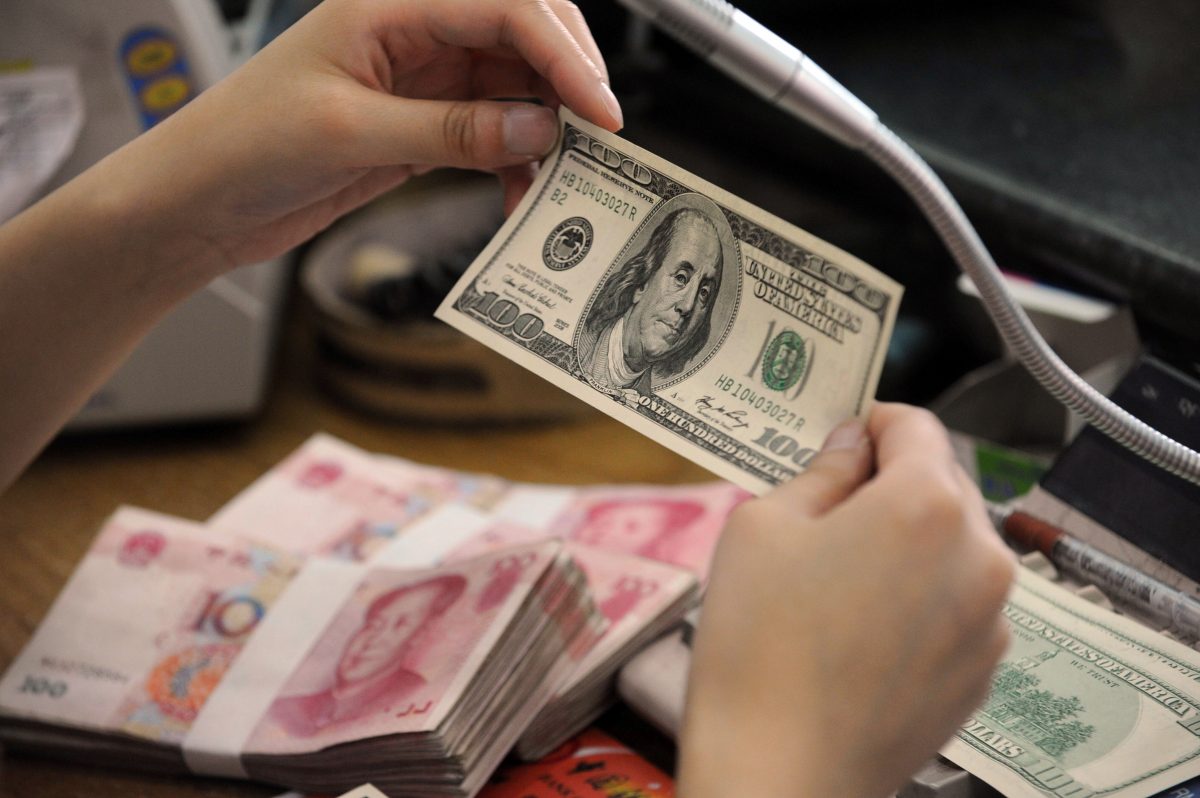
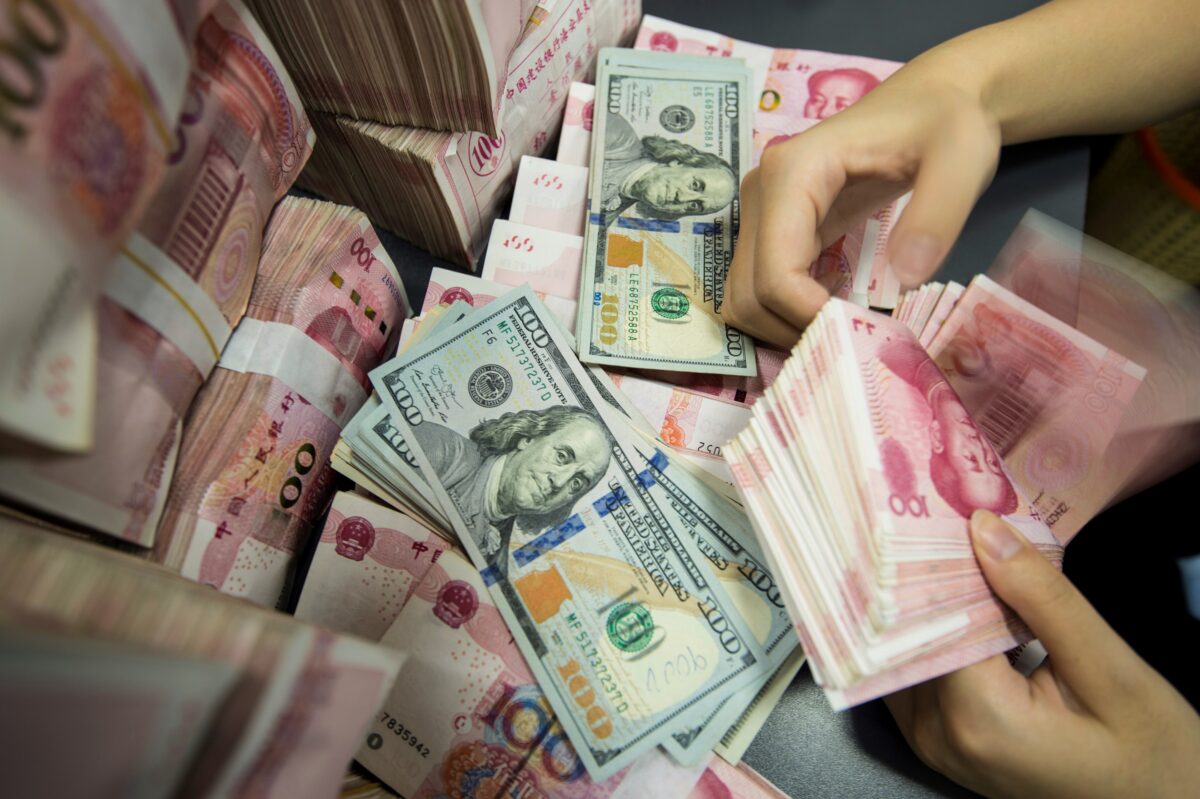
A Chinese bank worker checks a U.S. 100-dollar bill together with stacks of 100-yuan notes at a bank counter in Hefei City, Anhui Province, China, on Sept. 30, 2010.
Seizing a Golden Opportunity
The Chinese regime has been a major beneficiary of low-interest rate policies adopted by Western economies as they rushed to stem the economic fallout from the pandemic. Foreign investors have bought up China’s higher-yield bonds, pumping $135 billion into Chinese bonds in the 12 months ended Sept. 30, 2020, according to Bloomberg.
Global economic theory states that investors, credit concerns aside, would naturally divert funds away from low-interest rate economies (the U.S. for example) to high-interest rate economies (China for example). And to purchase Chinese bonds denominated in yuan, the investor would be required to sell dollars (currency of the low-interest rate economy) and purchase yuan in order to purchase the yuan bonds. This action, in theory, would increase the value of the yuan and devalue the dollar.
Di suggested last April that the regime should leverage the opportunities presented by the pandemic to attract more global investors, and release yuan to support foreign countries and companies in need of cash.
The Chinese regime has long expressed a desire to uproot the U.S. dollar as the world reserve currency. In 2009, then-governor of the regime’s central bank, Zhou Xiaochuan, called for the U.S. dollar to be replaced with an international reserve currency so the yuan could exert more influence.
According to the data compiled by the International Monetary Institute of Renmin University, the Chinese yuan’s share of global payments increased from 0.02 percent in 2011 to over three percent in 2020.
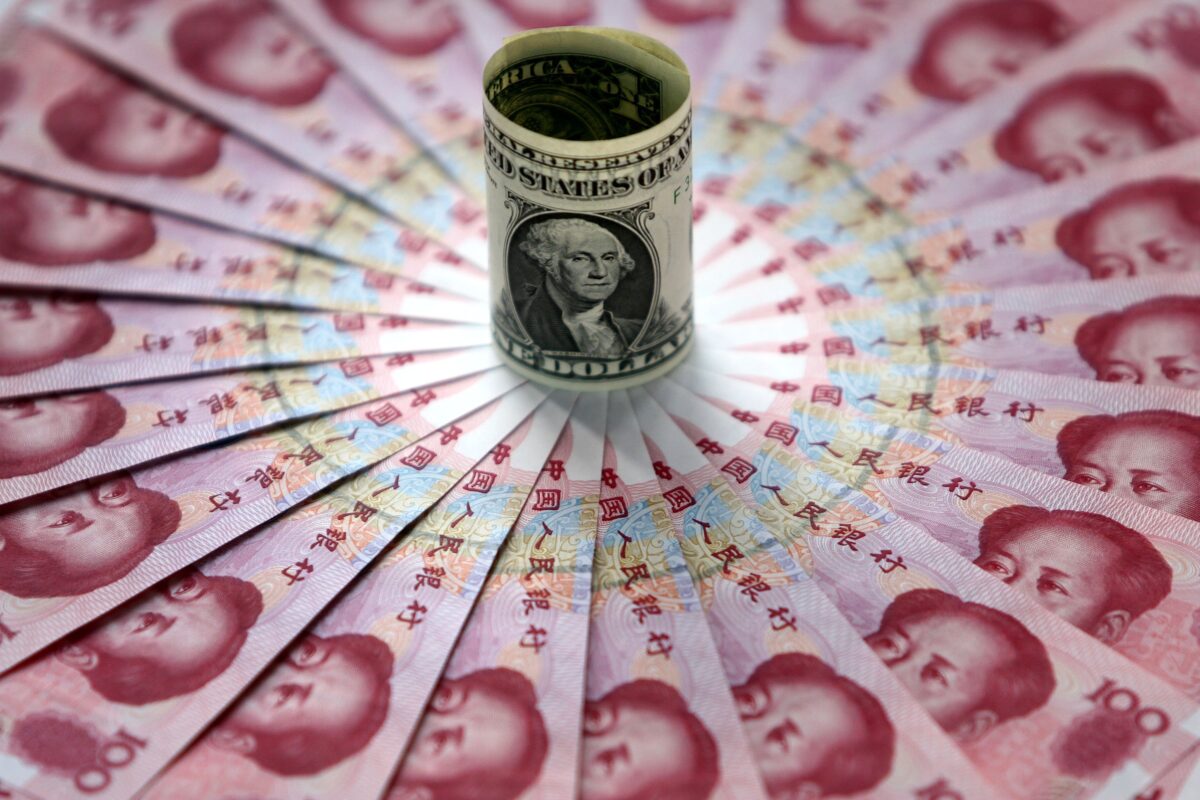
One dollar and 100 yuan notes are on display at a bank in Beijing, China, on May 15, 2006.
The yuan, however, still has a way to go to chase down the U.S. dollar’s dominance.
Di suggested the regime should issue loans to developing countries who otherwise would not be able to get loans from developed countries. This way, the regime could collect high-interest payments to offset the cost of relatively high-interest rates China pays on its bonds. But this ploy also faces higher risks of default.
Last April, Di implored the regime to be “extremely giving” to these developing countries. He suggested that Beijing could even sell its vast stash of foreign exchange reserves to provide for these loans.
Di said the flipside of taking on a large number of creditors is that it could push the yuan to strengthen too much and impair the regime’s ability to control the exchange rate. This presents a huge challenge for the regime—which has historically relied on a weak currency to spur exports.
For decades, critics have accused the regime of artificially devaluing its currency to help manufacturers, boosting exports.
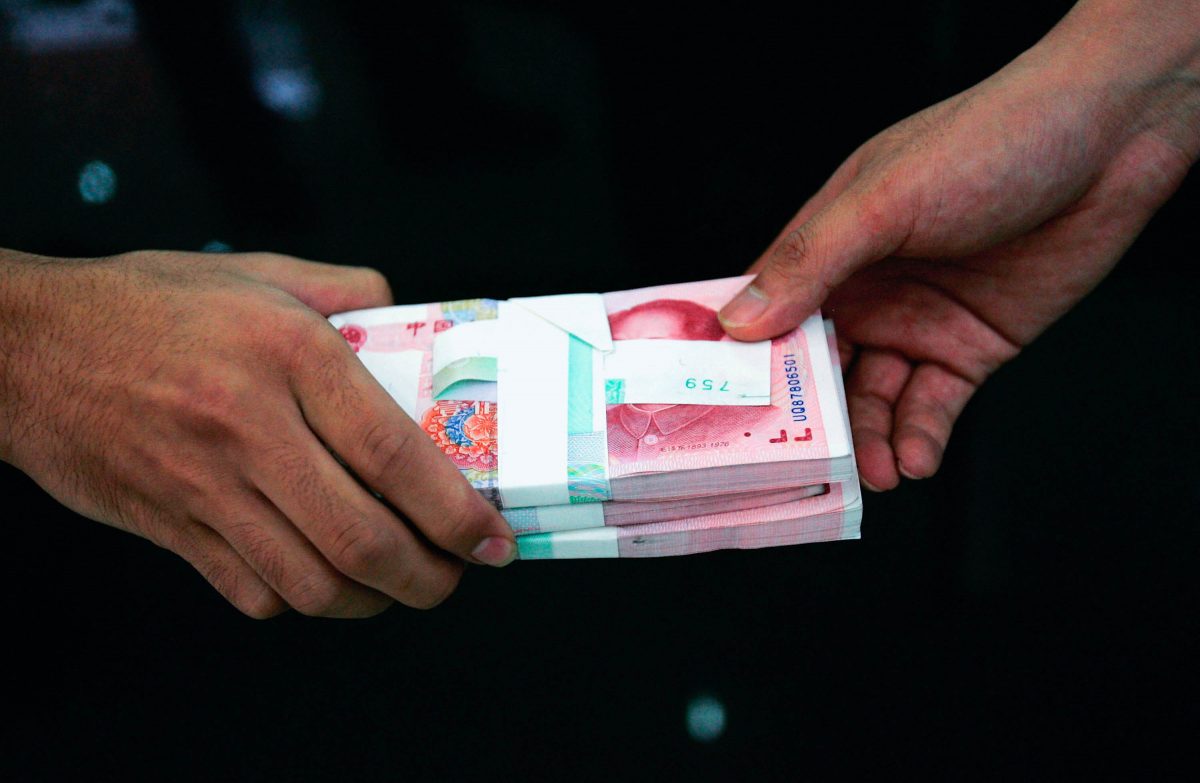
A clerk passes on stacks of Chinese yuan to another clerk at a bank in Beijing, China on July 22, 2005.
Further, creditors will dial-up scrutiny of Chinese financial markets, leaving less room for the regime to manipulate it, Di said.
The professor also recommended Beijing make regulatory changes to further stimulate foreign investment.
In the past decades, many foreign investors have been barred by the regime from transferring their proceeds away from the Chinese market (capital controls). Many Western businesspeople have also had their intellectual property stolen by local business partners or officials, and had no recourse due to the lack of rule of law in the country.
“[Our laws] should make other countries believe that China won’t confiscate other countries’ assets; make them believe that they can buy whatever they want to buy if they transfer their money to China; make them believe that they can withdraw their money whenever they want,” Di said in April 2020.
In 2019, the regime adopted the Foreign Investment Law, aimed at facilitating and protecting the rights of foreign investors. Those policies, Di said, had worked, citing the surge of foreign investment into China in 2020.
A Chinese bank employee counts 100-yuan notes and U.S. dollar bills at a bank counter in Nantong in China’s eastern Jiangsu Province on Aug. 28, 2019.
Leveraging Belt and Road
Another key component of the regime’s plan is to leverage Beijing’s Belt and Road Initiative (BRI) to boost the yuan’s circulation in developing countries, Di said.
BRI, previously known as One Belt One Road, is a massive global investment strategy launched by the CCP in 2013 aimed at bolstering its economic and political influence across Asia, Europe, Africa, and South America.
Di said the goal is to create a circulation of yuan inside BRI partner countries, particularly developing nations, representing billions of people: China would use yuan to invest in these countries, pay people they hire in these countries with yuan, and ask these countries to buy goods from China in yuan, and the cycle continues.
This would facilitate the circulation of yuan within and amongst BRI partner countries, legitimizing the Chinese currency in various niche markets as a form of exchange. As assets and goods are increasingly priced using the yuan, it would form a good basis to springboard further usage of the yuan among non-BRI countries, especially if they wish to do business or trade with BRI partner countries.
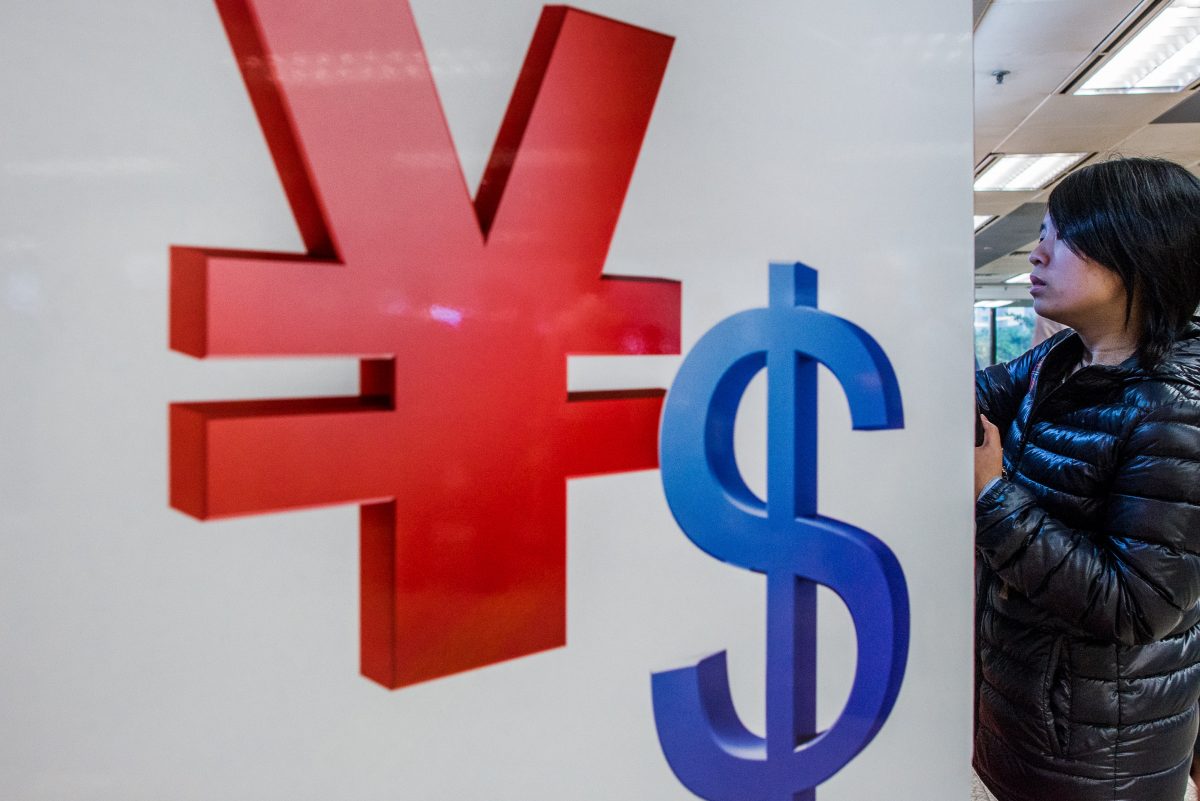
A woman uses an automatic teller machine (ATM) next to Chinese yuan (L) and U.S. dollar symbols in Hong Kong on November 28, 2012.
“Our target is these BRI partner countries’ equities, not bonds,” Di said in February. “We plan to use these equities to develop a global secondary market that is denominated in Chinese yuan. Then the capital in the world will be attracted to this market, to BRI projects.”
The professor said that foreign economists who think BRI is about chasing natural resources and minerals were wrong. Rather, the regime is interested in leveraging the human resources of the partner countries.
“The source of wealth is humans rather than things,” Di said.
The collapse of a bipartisan push is a sign of the ever-growing split in the Democratic Party
Getty Images
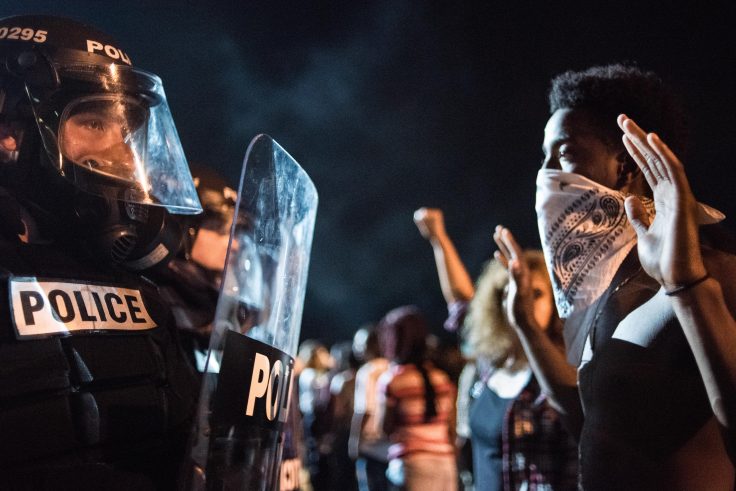
In a little-remarked vote in early March, House Democrats passed—again—the George Floyd Justice in Policing Act, their signature proposal to "reform" policing in the wake of last summer's widespread protests.
Two weeks later, the Movement for Black Lives came out against it. The coalition of more than 150 groups including the Black Lives Matter network blasted the bill, in a letter to congressional leadership, as a recapitulation of "incrementalist reforms."
This condemnation is a departure from the atmosphere of unity nine months ago, when Republicans and Democrats alike were floating proposals to overhaul policing nationwide. At the time, 95 percent of Americans endorsed the idea of at least minor changes to the criminal justice system, according to a poll conducted by the Associated Press and National Opinion Research Center.
The bills put forward last June offered a similar slate of proposals: mandatory use-of-force reporting, more money for body cameras, a ban on chokeholds—or, in Sen. Tim Scott’s (R., S.C.) bill, a ban on funding police departments that don't ban chokeholds—and a ban on no-knock raids. The two bills differed primarily over changes to the legal doctrine known as "qualified immunity," which protects police officers from prosecution in certain circumstances.
With all of that popular energy, what happened?
The two sides have blamed each other, and the usual partisan gridlock. But the loss of a major organizing backer suggests another challenge to Democrats' reform agenda: the party’s activist base. This dynamic not only challenges the possibility of effective reform—it could also cost Democrats much-needed voters as, evidence suggests, it already did in the surprisingly tight 2020 presidential race.
While Democratic leaders assiduously avoided growing calls from the party’s left flank to defund the police, activists embraced it. Rep. Ilhan Omar (D., Minn.) backed the push to defund the police department in Minneapolis, where violent crime has since soared, while fellow congressional "democratic socialists" Reps. Ayanna Pressley (D., Mass.), Cori Bush (D., Mo.), and Jamaal Bowman (D., N.Y.) endorsed the idea on social media.
"We're going to defund the police and refund our social services," Bush, then a candidate for Congress, wrote. "Don’t like this idea? Well, we don’t like dead Black & Brown bodies & broken families at the hands of those sworn to protect us. The police have failed at fixing themselves—so we're going to do it."
It’s from sentiments like these that an alternative to the mainstream Democratic and Republican proposals for police reform emerged: the BREATHE Act, a set of policies endorsed by Reps. Rashida Tlaib (D., Mich.) and Pressley. Though not yet formally drafted, the proposed effects of the bill would include abolishing ICE and the DEA, decriminalizing border crossings, ending mandatory minimum and life sentences, and pressuring states to repeal statutes implementing juvenile crimes.
Division over how far to go on criminal justice reform has fueled a broader divide in the Democratic caucus. In a widely leaked caucus call, Rep. Abigail Spanberger (D., Va.) blamed the push to defund the police for nearly costing her a hotly contested seat, while top Florida Democrats have said the movement helped hand President Donald Trump the state. Rep. Alexandria Ocasio-Cortez (D., N.Y.) fired back at Spanberger, suggesting it was a failure of campaigning, not of message, that cost Democrats valuable seats in the House.
The activist push is a response to the belief, common among the most liberal Americans, that police violence is an urgent problem. Polling from the Skeptic Research Center reveals that the further to the left one’s political beliefs, the more one overestimated the number of unarmed black men killed by police.
Misapprehensions like this help explain the urgency with which many liberals have called for radical change. A collective certainty that the criminal justice system is beyond repair animates a demand to not merely "reform" the system but tear it down altogether.
The party is still debating the impact that anti-police radicalism had on their electoral performance, but the signs are grim. Left-leaning analyst David Shorhas found that the biggest predictor of a voter's switch from Hillary Clinton in 2016 to Trump in 2020 is having "conservative views" on crime and public safety—as anti-police radicalism grew, Shor has argued, support for President Joe Biden, particularly among Hispanics, fell. Resurgent crime, political scientist Steven Teles has written, could even endanger Democrats’ ironclad grip on America’s big-city mayoralties, as voters back tough-on-crime GOP alternatives.
Congressional talks over a police reform bill are still ongoing, with no resolution in sight. Last year's pushback against policing, meanwhile, still appears to be driving a spike in homicide that has persisted into early 2021. Top Democratic leaders, including Biden, seem to understand that the "defund the police" movement is electorally poisonous. But its continued presence—among the activist base and among certain hardline elements of the party—will likely continue to weigh down efforts at more staid reform, long after popular enthusiasm has fizzled.
Youtube, the video hosting platform owned by Google, announced on March 29 thatthey are going to test making the “dislike” count on videos invisible.
“In response to creator feedback around well-being and targeted dislike campaigns, we’re testing a few new designs that don’t show the public dislike count,” YouTube announced on Twitter.
“If you’re part of this small experiment, you might spot one of these designs in the coming weeks.”
“Viewer feedback has always been, and will continue to be, an important part of YouTube. But we’ve heard from creators that the public dislike counts can impact their wellbeing, and may motivate a targeted campaign of dislikes on a creator’s video. So, we’re testing designs that don’t include the visible like or dislike count in an effort to balance improving the creator experience, while still making sure viewer feedback is accounted for and shared with the creator. ”
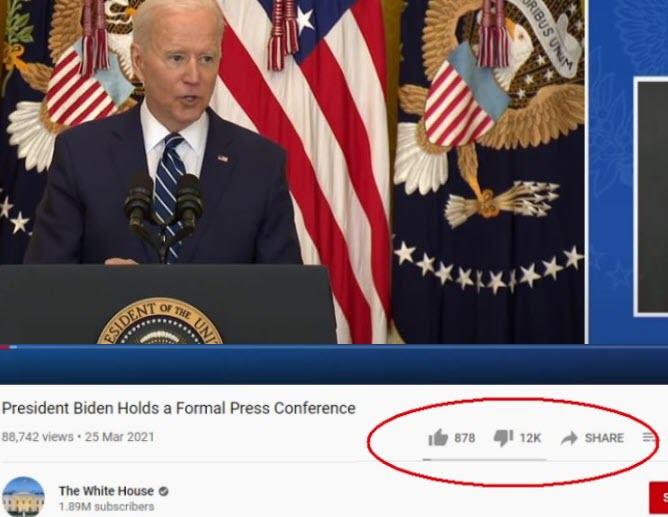
A majority of responses on both the Twitter announcement and on the support page disapprove of the idea, with some comments suggesting the move is a consequence of the tremendous imbalance of “dislikes” on the present administration’s videos on their White House channel.
Some other commentators expressed concerns that it would not be good for people who want to obtain feedback about the video quality, whether it be for creators or viewers.
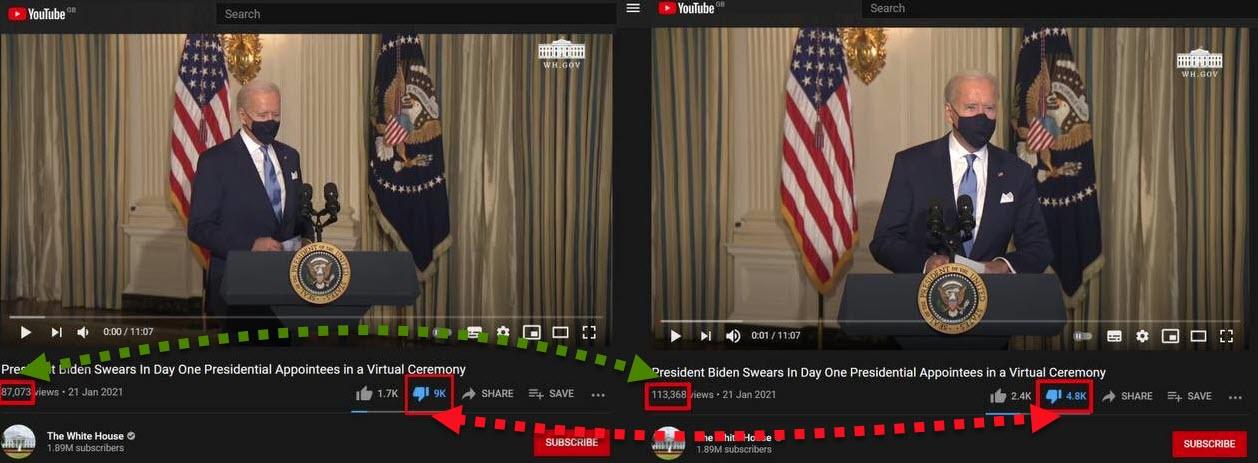
In January, YouTube deleted what appears to be thousands of “dislikes” from videos on the official channel of President Joe Biden’s White House. The company said it’s a part of its regular efforts to remove engagement it considers inauthentic.
People on the platform noticed that dislikes have been disappearing by the thousands from several White House videos and started posting before-and-after screenshots on social media shortly after the incoming administration took over the channel and published its first videos.
The screenshots indicate a total of at least 16,000 dislikes were removed from at least three videos. Even after the adjustments, the five videos on the channel had about 14,000 likes combined versus nearly 60,000 dislikes as of 3:30 p.m. on Jan. 21.
In response to a screenshot of one of the videos, YouTube told The Epoch Times that it’s monitoring engagement on the site to detect and remove activity it considers spam so that only engagement it considers organic remains. The mechanism worked as intended in the case of the Biden video, the company stated.
“YouTube regularly removes any spam likes or dislikes from your videos,” the company stated in a 2019 tweet.
“It may take up to 48 hours for the numbers to be updated.”
It isn’t clear how YouTube discerns between authentic and inauthentic engagement; the company didn’t immediately respond to a request for further details.
“No one wants this,” Nerdrotic, a pop-culture YouTuber tweeted, adding, “Dislikes are helpful for a great many things and this is what puts YouTube above all others.”
YouTube and its owner, Google, have long faced accusations of political bias. The companies have said their products are developed and run as politically neutral, but employee accounts and leaked internal materials indicate the companies are indeed infusing their politics into their products.
Google shifted millions of votes in the Nov. 3, 2020, presidential election by pushing its political agenda onto its users, according to research psychologist Robert Epstein, who assembled a team of more than 700 voters to monitor what results they were receiving from channels such as search results, reminders, search suggestions, and newsfeeds ahead of the election.
First Lady Jill Biden journeyed to California on Wednesday in a visit to a pop-up vaccination site for farmworkers designed to encourage others to join the national mass coronavirus vaccination program.
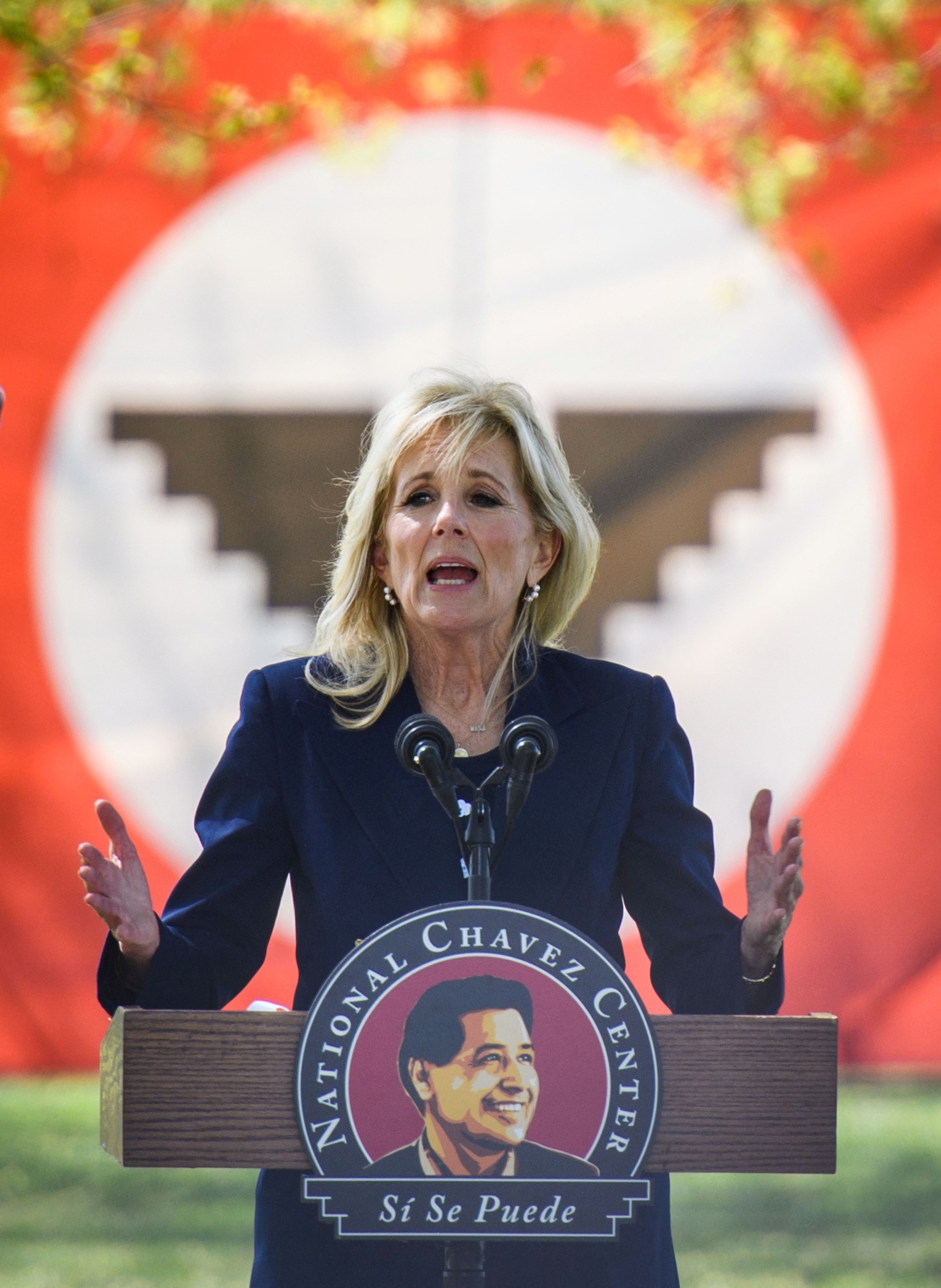
Video of her effort to speak Spanish to around 100 farm workers during the stop in Delano attracted almost as much attention as the flag that provided the backdrop. It came on the birthday of César Chávez, a left-wing labor leader, and she was joined by California Gov. Gavin Newsom.
“It’s ‘Si se puede’ (Yes you/we can) not ‘Si se pwadueh,’” RGA Deputy Communications Director Joanna Rodriguez tweeted. “I can’t even imagine what word she was trying to say. Seriously why even try pandering if you’re going to butcher it and not practice before?!”
Others were quick to join the commentary:
“Si se what???? I’m sure some one will surely tell Jill Biden ‘puadray’ is NOT a word in the Spanish dictionary,” Journalist Dania Alexandrino, a native Spanish speaker, tweeted. “For those who are celebrating her effort, yeah NO! Very far from ‘Si se Puede’ which means ‘Yes (we) can.’ We in parenthesis because it can also be yes you can!”
The Fresno Bee also pointed to what it called the “gaffe.”
The Daily Wire reports the clip soon went viral prompting journalists and commentators to question the red and black flag used as a backdrop.
Critics claimed it appeared to resemble Nazi imagery and the Reichsadler (Eagle of the German Empire), national insignia of Nazi Germany, flown from 1935 until 1945.
The flag was in fact nothing of the kind and the allegation wrong.
Rather it is the official flag of the United Farm Workers of America. The organization asserts the eagle featured on the standard was designed by César Chávez’s brother, Richard Chávez.
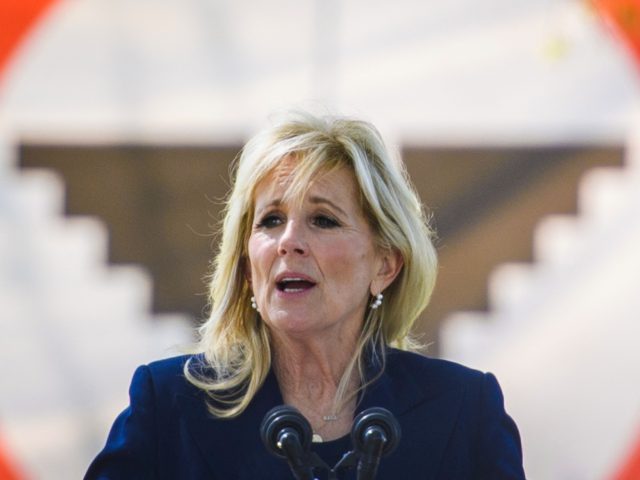
U.S. First Lady Jill Biden speaks during her visit to The Forty Acres, the first headquarters of the United Farm Workers labor union, in Delano, California on March 31, 2021. (MANDEL NGAN/POOL/AFP via Getty Images)
César Chávez co-founded the United Farm Workers of America (UFW) union and was a staunch opponent of illegal immigration, as Breitbart News has previously reported.
Even so, just hours before Jill Biden spoke President Joe Biden was also doing his best to contribute to the political makeover of the anti-migration, pro-American, labor-rights hero.
As Breitbart News reported, the president pushed the left-wing makeover in a March 31 statement, saying: “I was proud to place a bust of César Chávez in the Oval Office, so that no one who enters that historic room may forget the powerful truths his farm worker hands imparted.”