Instead of sipping champagne while making up fantasy stories of melting polar ice and dying polar bears, Wright challenges narratives and promotes policies that will not only help our nation, but the rest of the world.
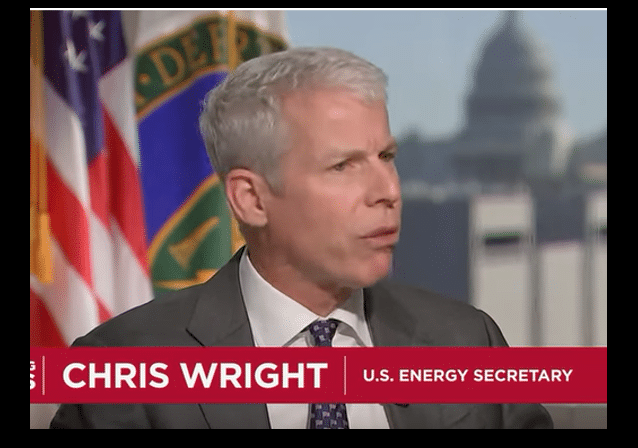
President Donald Trump’s current cabinet is a marked upgrade from the one he had in his first term.
Take, for example, the Department of Energy. When he was first nominated to head the agency, I reported that entrepreneur Chris Wright did not believe in the climate crisis hysteria. Rather, he is a proponent of ensuring our nation has inexpensive, efficient, and reliable energy.
Nor does he believe in ginned-up data from climate cultists, who want to pretend that solar and wind options are every bit as reliable and efficient as fossil fuels and nuclear. So, when confronted with the happy talk from the International Energy Agency on their “data”, Write said the organization needed to be reformed or the U.S. would no longer be a member.
In a July 15 interview with Bloomberg, U.S. Energy Secretary Chris Wright said he has told Fatih Birol, head of the International Energy Agency (IEA), his agency must either reform its forecasting methods or face potential U.S. withdrawal from the organization. This development reflects growing tensions between the Trump administration’s energy priorities and the IEA’s focus on clean energy transitions.
Wright’s criticism centers on the IEA’s reports and projections, which he and other critics of the agency argue are overly optimistic about renewable energy adoption and fail to adequately prioritize energy security. The debate underscores a broader ideological divide between the U.S. administration and many other western governments over global energy policy and could impact international cooperation and domestic energy strategies.
…Wright laid out the U.S. position in the Bloomberg interview, stating, “We will do one of two things: we will reform the way the IEA operates, or we will withdraw.” He expressed a preference for the former, saying, “My strong preference is to reform it,” in hopes his discussions with Birol and others can influence a return to the more balanced approach which formerly characterized IEA’s modeling approach.
Apparently, the IAE forecasts indicate the need for fossil fuels will “peak” before 2030...then go into decline.
…The IEA’s annual World Energy Outlook (WEO), which it previously styled the “gold standard of energy analysis”, has proclaimed the “Age of Electricity”, consistently projecting that demand for all three fossil fuels will peak before 2030 before going into permanent decline.
“That’s just total nonsense,” responded Wright, who was CEO of a US$2.8-billion oilfield services company before joining Donald Trump’s cabinet and taking over responsibility for his new boss’ analytically challenged “Drill, Baby, Drill” agenda. In an interview during a conference at Pittsburgh’s Carnegie Mellon University, Wright told Bloomberg he’d said as much to IEA Executive Director Fatih Birol.
“Wright’s criticism of the agency that gets millions of dollars in US funding is in line with Trump’s broader pro-fossil fuels thrust,” Bloomberg writes.
“We will do one of two things: we will reform the way the IEA operates or we will withdraw,”
Energy Secretary Chris Wright blasted the Paris-based International Energy Agency… pic.twitter.com/sR2viq1owI
— Walter Curt (@WCdispatch_) July 15, 2025
The IAE’s assertion defies all logic and reason. Take, for example, the more plausible projections of the Organization of Petroleum Exporting Countries (OPEC):
This forecast starkly contrasts with OPEC’s outlook, which anticipates oil demand rising to 123 million barrels per day by 2050, up from around 105 million bpd today.
OPEC has repeatedly criticized the IEA’s predictions as “dangerous,” warning they could lead to energy market volatility.
Furthermore, it is clear that the IAE numbers are not factoring in the energy-greedy artificial intelligence (AI) data centers. There are likely quite a number of them that will be built, and all of them will require a steady source of a great deal of energy that green energy cannot supply.
Interestingly, the biggest US grid ( PJM Interconnection, serving about 65–67 million people across 13 states and the District of Columbia) lacks the capacity to take on these facilities, according to a watchdog group.
“There is simply no new capacity to meet new loads,” said Joe Bowring, president of Monitoring Analytics, which is the independent watchdog for PJM Interconnection, the grid that extends from Washington to Chicago. “The solution is to make sure that people who want to build data centers are serious enough about it to bring their own generation.”
Artificial intelligence is driving the biggest US surge in electric demand in several decades, adding stress to grids that have proven vulnerable to extreme weather. PJM, which is home to the highest domestic concentration of data centers, has endured such tension for more than a year.
Tight supplies on PJM led to a record $14.7 billion in an annual auction last year. (The auction provides a key revenue source for generators within the system.) The results of the next auction, which are scheduled to be released late Tuesday, are expected to show capacity prices match or exceed all-time highs as the growth of data centers, especially for artificial intelligence, accelerates, according to Barclays Plc.
Ignoring economics and physics has real-world consequences. Just ask Spain.
Instead of sipping champagne while making up fantasy stories of melting polar ice and dying polar bears, Wright challenges narratives and promotes policies that will not only help our nation, but the rest of the world.
Personally, I like that in my Energy Secretary.
https://legalinsurrection.com/2025/07/energy-secretary-wright-threatens-to-take-u-s-out-of-international-energy-agency-over-climate-cult-supporting-forecasts/I can’t wait to laugh when this doesn’t happen.
pic.twitter.com/wApUUcQKEN
— Chris Martz (@ChrisMartzWX) July 25, 2025